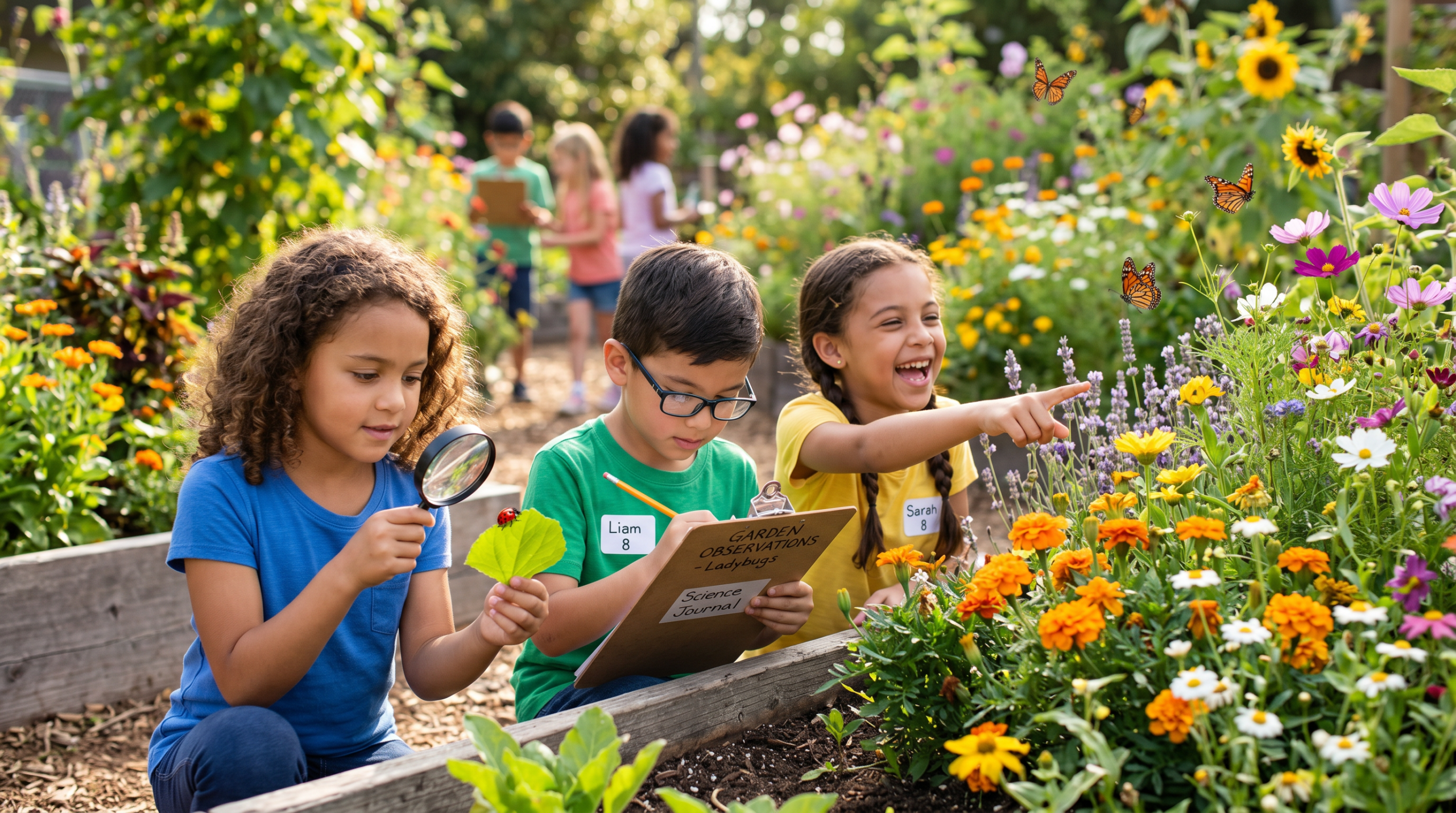
What a Biodiversity Survey Is
A biodiversity survey is exactly what it sounds like: a systematic effort to record all the different kinds of living things in a defined area over a defined period. The popular format known as a BioBlitz compresses this into an intensive burst — an afternoon, a day, a weekend — in which students fan out across the schoolyard documenting every plant, animal, fungus, and other organism they can find. The result is a snapshot of the area’s biodiversity at a particular moment, a baseline that can be revisited and compared over time.
The format is brilliant for education because it is at once a scavenger hunt and a genuine scientific census. It has a clear, motivating goal — find as many species as possible — that pulls students into close engagement with the natural world right outside their classroom. And it scales to any setting: a manicured campus, a wild corner, a single tree, or a planter box can all host a survey. What matters is not how wild the place is, but how carefully students look. The familiar schoolyard, examined closely for the first time, almost always turns out to be teeming with life that was invisible until someone decided to count it.
The Lost Art of Scientific Observation
At the heart of all science lies a deceptively simple skill: the ability to observe carefully. Before any hypothesis or experiment, a scientist must first notice — to look at the world with patient, focused attention and register what is actually there rather than what they assume. This is a skill that has quietly eroded in an age of glances and scrolling, and a biodiversity survey is one of the best ways to rebuild it. To count species, a student cannot simply glance at a lawn and move on; they must slow down, crouch low, and really look.
The moment students start looking closely, the world multiplies. What appeared to be uniform grass reveals three or four different plants. A single shrub turns out to host beetles, spiders, aphids, and a ladybug hunting them. The bark of a tree, examined inches away, becomes a landscape of lichen and moss. This shift — from seeing “a yard” to seeing dozens of distinct living things — is a profound cognitive change, and it is the very essence of scientific observation. Students learn to attend to detail, to distinguish similar things, to notice the small and the camouflaged, and to question their first, lazy impression of a scene.
Good observation also means using all the senses and tools available. Students learn to listen for birdsong and insect hum, to look under leaves and logs (returning them gently), to use a magnifying lens or a phone camera to see what the naked eye misses. They learn that observation is active and methodical, not passive — you go looking, you search systematically, you check the places life hides. This disciplined way of paying attention transfers directly to every other science, and indeed to any field where seeing clearly matters more than seeing quickly.
From Observation to Data: Recording It Right
Noticing something is only half the job; a scientist must record it in a way that is accurate, consistent, and useful to others. This is where a biodiversity survey teaches the craft of data collection, and it is a craft. For each organism found, students learn to capture the essential information: what it is (or what it appears to be), where it was found, when, and often how many. They photograph it, note its location, and log it — building a dataset one careful entry at a time.
The discipline of recording teaches lessons that reach far beyond biology. Students learn that data must be consistent — everyone recording in the same format, so the observations can be combined and compared. They learn the value of standardization: a survey that searches each area for the same amount of time, or covers the same-sized plots, produces results that can be fairly compared, while a haphazard search does not. They learn to distinguish a careful observation from a guess, and to flag uncertainty honestly rather than inventing an answer. These habits — consistency, standardization, honesty about uncertainty — are the bedrock of all credible data, and a survey instills them through practice rather than preaching.
What Each Observation Records
What. The organism — identified, or photographed for later identification.
Where. The exact location — increasingly captured automatically by GPS.
When. The date and time, so seasonal patterns can be tracked.
How many. Abundance — not just presence, but how common the species is.
Identification and the Order of Life
Putting a name to a living thing is its own rich lesson. Identification introduces students to taxonomy — the system scientists use to classify and name organisms, grouping them by shared characteristics into a vast, ordered tree of life. As students try to tell one species from another, they learn to look for the distinguishing features that matter: the shape of a leaf, the pattern on a wing, the number of legs, the structure of a flower. They begin to grasp that the living world is not a random jumble but an organized hierarchy, and that careful observation of features is how that order was discovered.
Modern tools make identification accessible without dumbing it down. Free platforms like iNaturalist — and its child-friendly companion app, Seek — let students photograph an organism and receive identification suggestions, with a global community of naturalists and experts helping to confirm the trickier ones. This design is clever and worth understanding: it separates collecting the observation from identifying the species, so a student who has no idea what they photographed can still contribute a valid, useful record that an expert later identifies. Students learn that they don’t need to be experts to do real science — they need to observe carefully and record honestly, and the identification can be crowdsourced. That lowers the barrier to entry while keeping the data rigorous.
Reading the Data: What the Count Reveals
Once the survey is done, the real thinking begins, because a list of species is raw material for analysis. Students learn key ecological measures: species richness (how many different kinds were found) and abundance (how many individuals of each). They discover that these two are not the same — an area can have many individuals of a few species, or few individuals of many species — and that biodiversity means more than a simple head count. Working with these ideas turns a nature walk into a genuine data analysis.
The most powerful insights come from comparison. Students can survey two different parts of the schoolyard — a mowed lawn versus an unmowed corner, a sunny bed versus a shady one — and compare the biodiversity of each, discovering how habitat shapes the life it supports. They can repeat the survey across seasons and watch the community change. They can ask why one area is richer than another and form testable hypotheses about light, water, food, and shelter. In this way, the survey becomes the front end of real ecological inquiry, teaching students to move from data to pattern to explanation — the core arc of science. The schoolyard stops being scenery and becomes a question worth investigating.
| Survey Step | The Skill It Builds |
|---|---|
| Searching the area | Careful, systematic scientific observation |
| Recording each find | Consistent, standardized data collection |
| Identifying species | Classification, taxonomy, and attention to features |
| Counting & comparing | Richness, abundance, and data analysis |
| Asking why | Hypothesis-building and ecological reasoning |
Real Data, Real Rigor
One of the most motivating aspects of a modern biodiversity survey is that the data students collect need not stay in the classroom. When observations are logged on platforms like iNaturalist, complete with photographs, GPS coordinates, and timestamps, they join a vast global database that real researchers actually use. Records like these have helped track species ranges, detect new arrivals, and monitor how wildlife responds to a changing climate. In 2016, a landmark BioBlitz organized by the National Park Service and National Geographic gathered observations from more than a hundred national parks, producing an unprecedented snapshot of biodiversity across the country — built largely by ordinary participants.
Knowing their work counts changes how students approach it. Suddenly, sloppy data isn’t just a bad grade — it’s a flawed contribution to a real scientific record, and accuracy matters. Students take more care with their photographs and notes, double-check their locations, and think about whether their observation is solid enough to be useful to a stranger. This is exactly the mindset of a working scientist, and it elevates the whole exercise from a school activity to a genuine, if modest, contribution to human knowledge. The schoolyard becomes one small node in a planet-spanning effort to understand life on Earth.
How to Run a Schoolyard Survey
Starting a biodiversity survey is wonderfully low-cost. Define a manageable area — even a single garden bed or a corner of the field — set a time limit, and equip students with little more than a phone or camera, a notebook, and curiosity. A free identification app lowers the barrier to naming what they find, and clear instructions on how to record each observation keep the data consistent. Beginning small and focused builds confidence and produces cleaner data than turning students loose on the whole campus at once.
From there, the survey can grow into a recurring tradition. Repeating it each season or each year builds a longitudinal dataset that reveals change over time — one of the most valuable things a school can create and one of the hardest to get any other way. Assigning roles (searchers, photographers, recorders, identifiers) spreads ownership, and sharing the results — a class field guide, a display, a contribution to a global database — gives the work a satisfying conclusion. Treat the first survey as a pilot, refine the method, and let the schoolyard become a place students return to with the patient, attentive eyes of real naturalists.
Frequently Asked Questions
Do students need to know how to identify species first?
No. Identification apps and the crowdsourced model of platforms like iNaturalist mean a student can photograph anything and have it identified later by the community. The key skills are observing carefully and recording accurately — identification can follow.
What if our schoolyard seems to have no wildlife?
Every schoolyard has far more life than it appears to. Even a paved campus hosts plants in cracks, insects, spiders, birds, and lichens. The surprise of finding so much in a “boring” place is often the most powerful part of the lesson.
Is the data students collect actually useful to scientists?
Yes, when recorded well. Observations with clear photos, locations, and dates uploaded to platforms like iNaturalist contribute to real biodiversity databases that researchers use to study species ranges, detect new arrivals, and track ecological change.
Look Closer, Count Carefully
A schoolyard biodiversity survey takes the most ordinary ground and reveals it as a living world worth counting. In doing so, it teaches the two skills every scientist is built on: the patient observation that notices what others miss, and the disciplined data collection that turns noticing into knowledge anyone can use.
All it takes is a defined patch, a time limit, a camera, and the decision to look closely. Students will discover a hidden richness right outside the classroom — and discover, too, that they are capable of real scientific work. Count the life around you carefully, and you learn to see the whole world with sharper eyes.
Science begins the moment you truly start to look.
This article is for general educational purposes. For tools and guidance, see the National Geographic BioBlitz program and iNaturalist (and its child-safe Seek app). Supervise students outdoors, respect living things, and follow local guidance on handling wildlife.
Leave a Reply