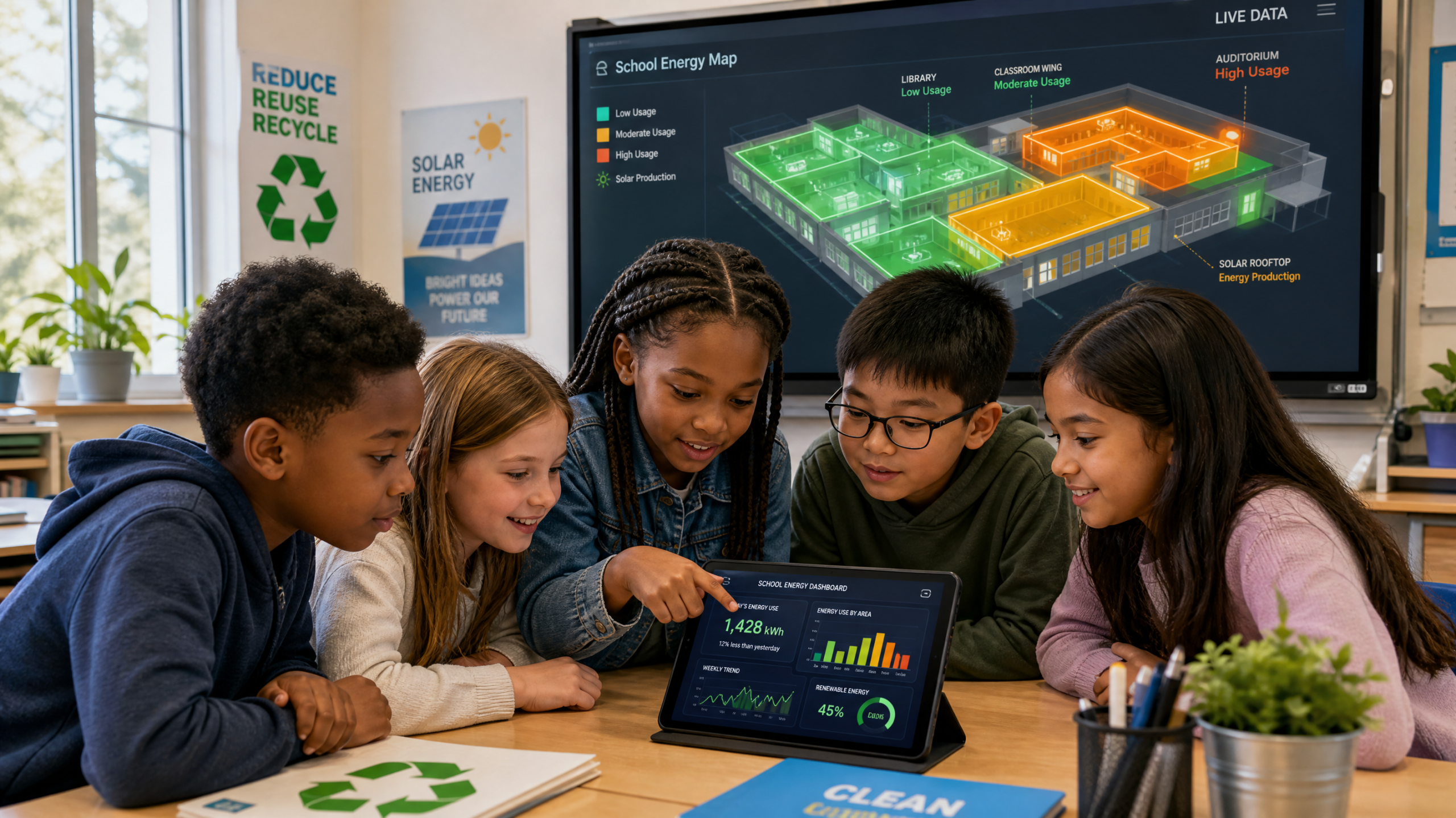
Why a School Is the Perfect Dataset
Good data education needs data students can believe in, and a school building delivers it. The numbers are real — nobody invented them for a worksheet. They are local — they describe this gym, these hallways, that aging boiler. They are consequential — American K-12 districts spend more than eight billion dollars a year on energy, according to the EPA’s ENERGY STAR program, money that competes directly with teachers and programs. And they are continuous: a new bill arrives every month, so the dataset never stops growing.
There is one more quality that textbook data almost never has: a school’s energy data is usefully messy. Usage spikes in a heat wave and collapses over winter break. A new computer lab bends the trend. A single bad meter reading throws off a month. Learning to spot the anomaly, ask whether it’s an error or a real event, and decide what to do about it is the actual work of data literacy — and a clean, pre-packaged dataset never teaches it. The school’s electricity footprint is the rare dataset that is rigorous enough to learn from and human enough to care about.
Reading the Meter: Where the Numbers Come From
The audit begins with a skill most adults never master: reading an electric bill. The headline number is consumption, measured in kilowatt-hours (kWh) — a unit worth dissecting, since a “kilowatt” is a rate of power and a “kilowatt-hour” is the energy used by running that power for an hour. Confusing the two is one of the most common mistakes in energy, and untangling it is a clean lesson in units and dimensional reasoning. The bill often carries a second charge students find surprising: a demand charge, based not on total energy used but on the single highest spike of power drawn during the month — which is why a school can cut its bill by spreading out when big equipment runs, not just by using less overall.
Then comes the move that separates raw data from insight: normalization. A big school will always use more energy than a small one, so comparing their totals is meaningless. The standard fix is Energy Use Intensity (EUI) — energy used per square foot per year — which lets a 40,000-square-foot elementary school be compared fairly against a 200,000-square-foot high school. The day students realize that the “biggest” energy user might actually be the most efficient one, once you account for size, is the day they understand why professionals never trust a number until they know what it’s divided by. That single idea — that a figure means nothing without its denominator — is among the most transferable lessons in all of data literacy.
Benchmarking: Turning Numbers Into Meaning
A single EUI tells you what your school uses. It does not tell you whether that’s good or bad — and the leap from “what is the number” to “what does the number mean” is exactly where data literacy lives. The professional tool for that leap is free and public: the EPA’s ENERGY STAR Portfolio Manager, which compares a building against a national database of similar ones and returns a score from 1 to 100. A score of 50 is exactly average; a 75 or above is efficient enough to earn ENERGY STAR certification. Feeding a school’s twelve months of bills into that tool, and watching it spit back a percentile, teaches the difference between an absolute number and a relative one in the most vivid way possible.
The benchmark is also where the stakes come into focus. The EPA estimates that more than thirty percent of the energy used in a typical commercial building is wasted, and that roughly ten percent can be recovered through low- and no-cost measures alone. Schools that earn ENERGY STAR certification use on the order of thirty-five percent less energy than their peers. Put those figures next to your own school’s score and the data stops being an exercise — it becomes a gap, with a dollar value, that students can argue about and try to close. They are no longer reading statistics; they are using them.
What the Benchmark Teaches
A number needs a comparison. “We used 900,000 kWh” means nothing until you ask: compared to what?
Percentiles and rank. A 1–100 score is a lesson in relative position, not absolute value.
Normalization is everything. The score adjusts for size, climate, and hours — so the comparison is fair.
The Walk-Through: Collecting Your Own Data
Bills tell you how much the whole building uses; they don’t tell you where it goes. To find that out, students become the instrument — and primary data collection is a different and equally important skill. Armed with a plug-in power meter, a thermometer, and a simple light meter (or the sensors already inside a smartphone), a class can walk the building and measure. They will find phantom load: the electricity drawn by devices that are “off” but still plugged in — monitors, printers, chargers, the vending machine humming all weekend. They will measure how much a row of older fluorescent fixtures pulls versus an LED replacement, and discover that a thermostat set a few degrees too aggressively can dwarf every other saving in the room.
This is where the soft skills of data become real. Students learn to sample rather than measure everything, to record observations consistently so the numbers can be compared, to notice when a reading looks wrong and take it again, and to separate a measurement from a guess. They learn that data collection is a craft with its own discipline — that sloppy inputs poison every conclusion downstream. The EPA’s free K-12 Energy Efficiency Student Toolkit lays out classroom-ready versions of exactly these investigations, turning the walk-through into a structured project rather than a scavenger hunt.
| Audit Stage | Data-Literacy Skill It Builds |
|---|---|
| Reading the bill | Units, rates, and the difference between power (kW) and energy (kWh) |
| Calculating EUI | Normalization — why a number needs a denominator to mean anything |
| Benchmarking | Comparison, percentiles, and relative vs. absolute values |
| Walk-through measuring | Primary data collection, sampling, and measurement error |
| Reporting findings | Visualization, honest charts, and arguing a case from evidence |
From Data to Decision — and Back Again
Collecting numbers is only the first half; the harder, more valuable half is turning them into an argument. Here students build charts — and learn that how you draw a chart can mislead as easily as inform, that a truncated axis or a cherry-picked month can make a flat trend look like a crisis. They form a hypothesis (“the gym lighting is our biggest waste”) and test it against what they actually measured. They write a recommendation a real decision-maker could act on, complete with an estimated cost, an estimated saving, and the payback time — the same logic a facilities director uses. This is the moment data literacy becomes persuasion, and a spreadsheet becomes a proposal.
The most powerful version of the project closes the loop. A class recommends a change — switching off phantom loads over breaks, adjusting a thermostat schedule, swapping a bank of bulbs — the school tries it, and the next bill measures whether it worked. “What gets measured gets managed” stops being a slogan when students can point to the dip in the data that their own analysis caused. Free, classroom-friendly resources from the EIA Energy Kids program and the ENERGY STAR materials above give teachers a structured path through every stage. The school keeps producing data whether anyone studies it or not. The audit simply decides to listen — and turns a monthly bill into one of the best data-literacy lessons a student will ever get.
The Dataset Was There All Along
Schools spend a fortune teaching data with invented examples while a far better one sits in the front office: twelve months of real, local, high-stakes numbers, refreshed every billing cycle. A classroom energy audit walks students through the entire arc of data work — read it, normalize it, benchmark it, collect more of it by hand, and argue from it toward a decision that the next bill will judge.
The skills transfer far beyond electricity. A student who learns to ask “compared to what?”, to distrust a number without its denominator, to suspect a too-clean chart, and to back a recommendation with evidence has learned to think with data — the literacy that increasingly separates those who use information from those who are used by it.
Read the meter. Question the number. Make the case.
This article is for general educational purposes. For benchmarking tools and classroom resources, see the U.S. EPA’s ENERGY STAR for K-12 Schools, Portfolio Manager, the K-12 Energy Efficiency Student Toolkit, and the EIA Energy Kids program.
Leave a Reply