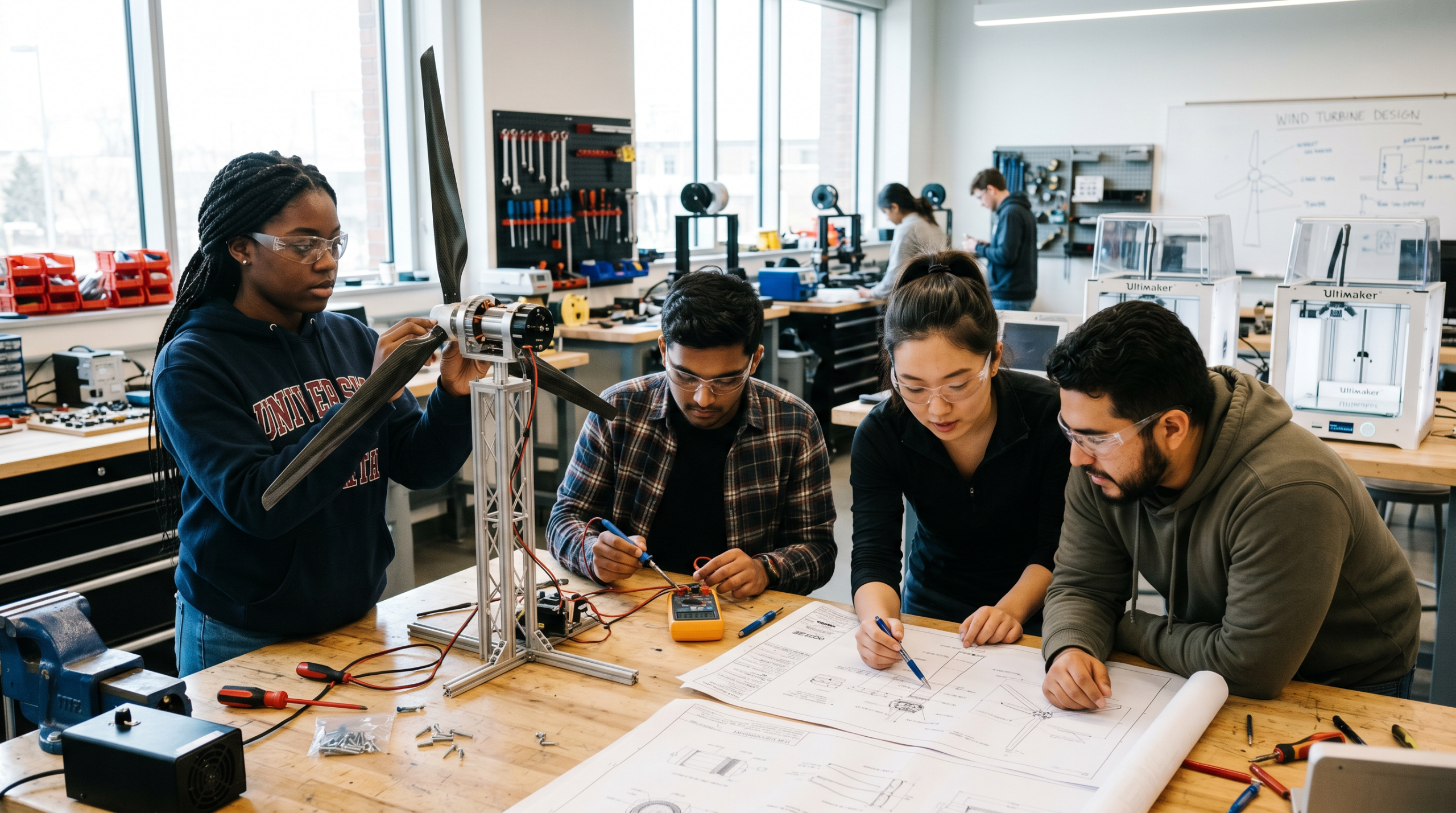
The Engineering Design Process, Made Real
Every engineering classroom teaches the same cycle: define the problem, plan, build, test, improve, repeat. On paper it is a tidy diagram with arrows. A wind turbine turns it into something students can feel. The challenge is concrete and the goal is measurable — generate the most electrical power from a fixed wind source — which means there is always a number telling you whether your latest idea was better or worse than the last. That single feature, an honest score that can’t be argued with, is what separates real engineering from a craft project.
The structure used by design competitions captures it well: plan your approach and research how turbines work, build a turbine that actually functions, then test it, measure its output, and use what you learn to improve the next version. The loop is the whole point. A student who builds one turbine has done a project; a student who builds five, each informed by the failures of the last, has learned to engineer. The measurable goal forces the iteration, and the iteration is where the learning lives.
The Design Loop on a Turbine
Plan. Research lift, blade angle, and gearing; sketch a first design and predict how it will perform.
Build. Construct blades, hub, and tower from simple materials — and discover that paper specs meet physical reality.
Test. Measure voltage and power output under a steady wind; record the number.
Improve. Change one thing, test again, and prove whether it helped. Then do it all once more.
The Physics You Have to Wrestle With
A turbine looks simple and is anything but, which is exactly what makes it teach. The blades work not by being pushed like a sail but by generating lift, the same force that holds an airplane up — and so the angle of the blade (its pitch) becomes a decision with consequences. Too flat, and the wind slides past doing little work; too steep, and the blade stalls and stops. Somewhere between lies an optimum a student can only find by testing. The same goes for nearly every other choice: how many blades, how long they are, what shape, and how the spinning shaft connects through a gear ratio to the generator that actually makes the electricity.
What makes this real engineering rather than trivia is that the choices trade off against each other. Longer blades sweep more air and capture more energy, but they are heavier and can flex, bend, and strike the tower at high wind speeds. More blades can start turning in a gentle breeze but add drag at speed. A gear ratio that spins the generator faster raises voltage but demands more torque to turn. There is no single right answer printed in the back of a book — only a balance the team has to discover for its particular design, under its particular test conditions. Resources from research institutions like the National Renewable Energy Laboratory show students that the same trade-offs scale all the way up to the giant turbines on a real wind farm.
Why Failure Is the Point
In most school tasks, a thing that breaks is a failure to be graded down. In engineering, a thing that breaks is information. When a blade bends and clips the tower, throwing the whole turbine out of balance, the team has just learned something true about their design that no amount of planning would have revealed. The students who do best are the ones who stop treating the broken turbine as a verdict and start treating it as a clue — a debugging mindset that transfers directly to coding, to lab science, to any field where things go wrong before they go right.
Crucially, the turbine teaches the discipline of changing one variable at a time. A team that redesigns the blades, the gearing, and the tower all at once and sees a better number has learned nothing, because they cannot say which change helped. The team that alters only the blade pitch, tests, records, and then moves to the next variable is running a controlled experiment without ever being told that’s what it’s called. They are learning that careful method beats clever guessing — perhaps the most durable lesson engineering has to offer.
| Design Choice | The Engineering Trade-Off It Teaches |
|---|---|
| Blade pitch (angle) | Lift vs. stall — finding the optimum by testing, not guessing |
| Blade length | More swept area and energy vs. more weight, flex, and failure risk |
| Number of blades | Easy start-up in light wind vs. added drag at higher speeds |
| Gear ratio | Higher generator speed and voltage vs. the torque needed to drive it |
| Tower & balance | Stability and material strength vs. weight and vibration |
The Problem-Solving Habits It Builds
Strip away the wind and the wattage, and what a turbine project really trains is a way of thinking. Students learn to work inside constraints — a fixed budget of materials, a set wind speed, a deadline — which is the condition under which all real engineering happens. They learn to document what they tried and what resulted, because a result you can’t reproduce is barely a result at all. And because turbines are almost always built by teams, they learn to divide a hard problem, argue about a design without taking it personally, and combine partial answers into a working whole. These are not soft extras; they are the core competencies that engineering employers and science programs say they want most.
There is also a quieter benefit: confidence with the physical world. A student who has wired a generator, measured its output, and made a real object do something useful carries a different relationship to technology than one who has only read about it. Educational programs like the EIA’s Energy Kids pair this kind of build with the background knowledge to understand it, so the turbine is not a one-off stunt but a doorway into how energy actually works. The student stops being a passive user of devices and starts being someone who can take one apart, understand it, and improve it.
From the Classroom to a Career
The skills a turbine build develops are the same ones that power a fast-growing part of the economy. Competitions give students a taste of the real thing: design under rules, defend your choices to a panel of judges, and watch your turbine tested in a wind tunnel against everyone else’s. Win or lose, a student walks away having practiced the full arc — research, design, build, test, present — that defines an engineering career. For many, it is the first time school work has felt like the actual job.
And the lesson generalizes far beyond wind. The student who learned to isolate a variable, accept a failure as data, and iterate toward a measurable goal has acquired a method that works on a bridge, an algorithm, a business plan, or a science experiment. The turbine was never really about the turbine. It was a safe, cheap, vivid place to learn how to solve a hard problem you don’t yet know the answer to — which is, in the end, what engineering is.
Let Them Build the Broken One First
A student-built wind turbine is a rare classroom tool that refuses to let anyone fake understanding. The wind doesn’t care about a tidy report; the voltmeter only responds to a design that actually works. That honesty is what makes the project teach engineering, physics, and problem-solving all at once — and what makes the inevitable early failures the most valuable part.
For any school looking to make engineering real, the recipe is cheap and the payoff is large: set a measurable goal, supply simple materials, and let students plan, build, test, and improve their way to a turbine that spins. They will learn more from the version that fails than from any diagram — and they will learn it in a way they don’t forget.
Plan, build, test, improve — then do it again.
This article is for general educational purposes. For wind-energy projects and classroom resources, see the KidWind Challenge, the National Renewable Energy Laboratory, and the U.S. EIA’s Energy Kids program. Always supervise hands-on builds and follow safety guidance when working with tools and electrical components.
Leave a Reply