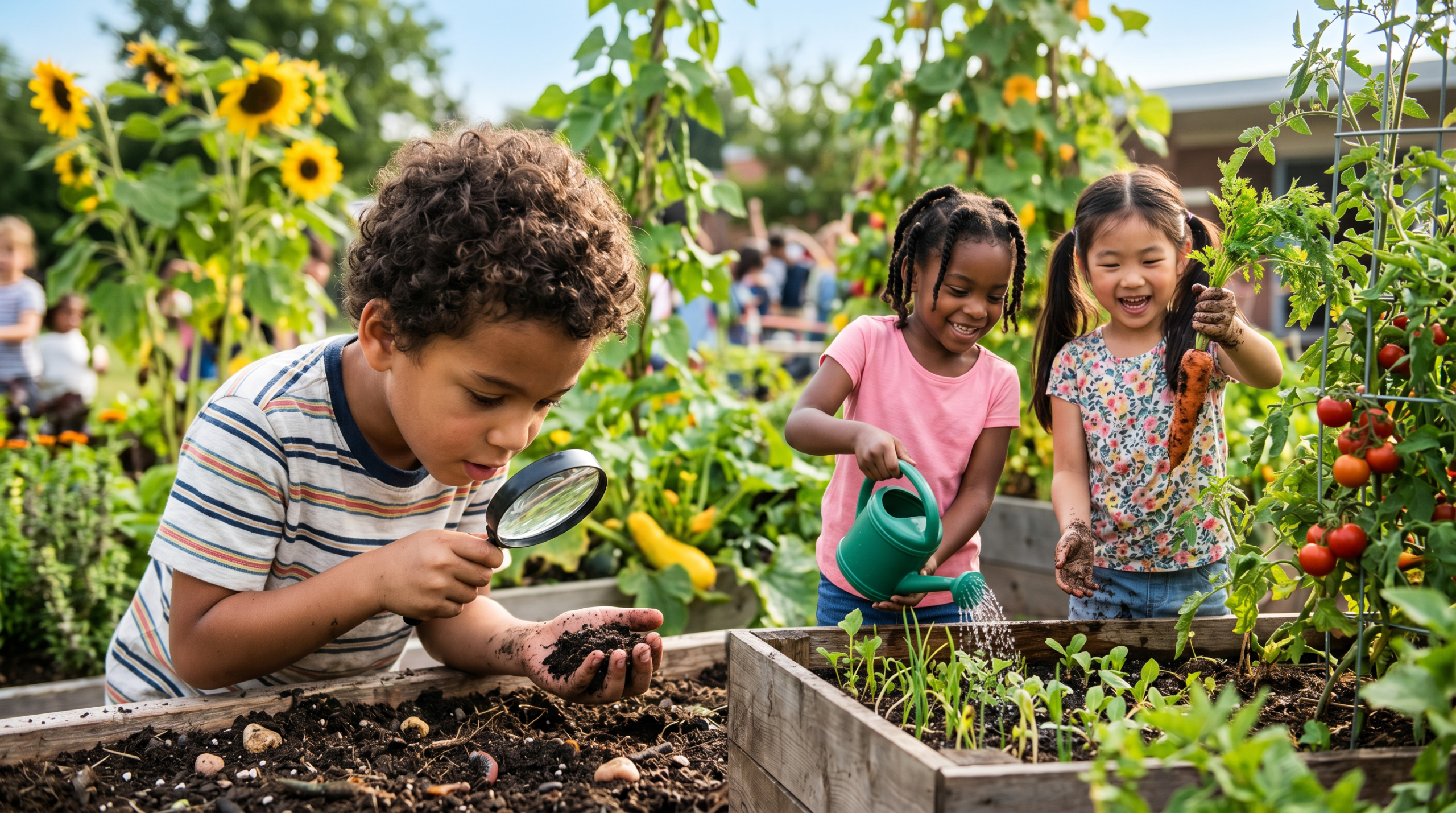
A Garden Is an Ecosystem, Not a Flowerbed
The first shift a school garden asks of students is conceptual: stop seeing a collection of individual plants and start seeing a system in which everything is connected. A tomato plant is not a standalone object. It depends on the structure of the soil holding its roots, on fungi and bacteria delivering nutrients to those roots, on bees carrying pollen from flower to flower, on the worms aerating the bed, and on the sun and rain that drive the whole engine. Pull one thread — let the soil dry out, lose the pollinators, exhaust the nutrients — and the effect ripples through everything else.
This is the core idea of ecology, and a garden makes it tangible in a way nothing else can. Students watch cause and effect unfold in real time and at a human pace: a bed that was ignored for a week tells its own story; a sudden infestation of aphids invites a conversation about predators and balance; a wilting row prompts a hunt for the missing variable. Because the system is right there to be observed, touched, and tested, students aren’t memorizing the definition of an ecosystem. They are living inside one they helped create, learning that healthy growth is never the work of a single factor but of many working together.
Soil Science: The Living World Underfoot
Ask most people what soil is, and they will say “dirt.” A school garden corrects that misconception fast. Soil is one of the most biologically active substances on Earth — a single handful can contain billions of microorganisms. Beneath the surface of every garden bed runs a hidden food web: bacteria and fungi break down organic matter, protozoa and nematodes feed on them, earthworms tunnel and digest their way through the soil, and the waste products of all this activity become the nutrients plants absorb. When students dig in, they are not playing in dirt; they are exploring a thriving underground civilization.
From this living foundation, real chemistry and biology emerge naturally. Students learn that plants need three primary nutrients — nitrogen for leafy growth, phosphorus for roots and flowers, and potassium for overall vigor — along with a host of micronutrients, and that these must be available in the right balance. They learn that soil pH, its acidity or alkalinity, controls whether those nutrients can even be taken up: a perfectly fertilized bed can still starve a plant if the pH is wrong. They learn to read soil texture by feel, distinguishing sandy soil that drains too fast from clay that holds too much water, and to understand why compost — decomposed organic matter — improves nearly every kind of soil by feeding the microbes and improving structure.
What the Soil Itself Teaches
The soil food web. Decomposers turn dead matter into plant food — a recycling system students can see and smell.
Nutrients & balance. Nitrogen, phosphorus, and potassium each do a specific job, and too much is as harmful as too little.
pH matters. The chemistry of the soil decides whether nutrients are available at all.
Structure & life. Worms, roots, and compost build the crumbly, breathing soil that healthy plants need.
Best of all, soil science in a garden is a science of experiments. Students can test the pH of two beds and predict which plants will thrive in each. They can add compost to one row and leave another bare, then measure the difference weeks later. They can set up a small worm bin and watch decomposition happen in fast-forward. Each of these is a genuine investigation with a measurable result — the scientific method practiced in the most concrete way possible, with hands in the earth instead of answers in the margin.
Nutrition: From Soil to Plate
There is a well-documented phenomenon in school gardens that surprises every first-time teacher: children will eat vegetables they grew themselves that they would never have touched on a cafeteria tray. A child who refuses salad will proudly munch on a leaf of kale they planted, watered, and watched grow. The garden transforms food from something handed to them into something they made — and that sense of ownership rewires the relationship with eating. This is precisely why nutrition education sits at the heart of the federal Farm to School approach, which pairs growing with tasting and cooking.
Beyond willingness to try new foods, the garden builds what nutrition educators call food literacy — an understanding of where food actually comes from. Many children genuinely do not know that a carrot grows underground, that a potato is a tuber, or that the strawberry they love took months to ripen. Watching the full journey from seed to harvest closes that gap. Students learn which parts of a plant we eat — roots, stems, leaves, flowers, fruits, seeds — and begin to grasp why a plate full of varied colors tends to mean a plate full of varied nutrients. They connect the abstract idea of “eat your vegetables” to the very real plants they tended, and the lesson lands because they lived it.
The connection runs deeper still when the harvest reaches the kitchen. A garden gives a natural, irresistible reason to cook, taste, and talk about food: a salsa made from the garden’s tomatoes and peppers, a stir-fry of its greens, a salad dressed and shared at the bed’s edge. In these moments nutrition stops being a worksheet about food groups and becomes a sensory, social, memorable experience. Children develop preferences for fresh, whole foods at exactly the age when lifelong eating habits are forming — arguably the most valuable health outcome a school can offer.
Patience: The Lesson You Cannot Rush
We live in an age of instant everything, and a garden refuses to play along. You cannot fast-forward a seed. A radish takes a month, a tomato most of a summer, an apple tree years before its first fruit. For students raised on screens that respond to every tap, the garden offers a profound and increasingly rare lesson: some good things take time, and the only way through that time is patience and steady care. The seed planted today does nothing visible tomorrow. It demands faith, attention, and the willingness to keep watering something that has not yet rewarded you.
This patience is not passive waiting; it is active stewardship. A garden must be tended consistently or it fails — weeds crowd, pests arrive, drought sets in. Students learn that results follow from repeated small efforts rather than a single dramatic action, a lesson that quietly transfers to study habits, skill-building, and nearly everything else worth doing. They also learn to observe closely over time, noticing the slow daily changes that add up to growth, which sharpens both their attention and their understanding of natural processes.
And the garden teaches how to handle failure with grace. Some seeds never sprout. A frost takes the seedlings. A summer pest wins. In a garden, these setbacks are not catastrophes but part of the cycle — you note what happened, adjust, and plant again next season. Children learn that failure is information, not a verdict, and that resilience means returning to the work rather than abandoning it. Few lessons in school are as honest, or as gentle, as a garden’s reminder that nature operates on its own schedule and rewards those who keep showing up.
| Garden Element | What It Teaches |
|---|---|
| Soil & compost | Decomposition, the nutrient cycle, soil chemistry and pH |
| Seeds & growth | Plant life cycles, patience, observation over time |
| Pollinators & pests | Food webs, balance, interdependence in an ecosystem |
| Harvest & kitchen | Nutrition, food literacy, healthy eating habits |
| Seasons & setbacks | Resilience, stewardship, working with natural cycles |
One Garden, Every Subject
A school garden’s greatest practical strength is that it does not belong to a single class. It is a cross-curricular tool that touches nearly every subject, which is why it earns its space on a crowded campus. In math, students measure beds, calculate planting spacing, count seeds, track growth rates, and weigh harvests. In science, the garden supplies endless material for biology, chemistry, and earth science. In language arts, students keep observation journals, research the plants they grow, and write about the experience. In art, they sketch leaves, photograph the changing beds, and design signage. In social studies, the garden opens conversations about agriculture, history, culture, and where communities get their food.
Organizations such as National Agriculture in the Classroom offer standards-aligned lessons that make these connections explicit, so teachers don’t have to invent the curriculum from scratch. The result is learning that feels integrated rather than fragmented — a single living context in which a math skill, a science concept, and a piece of writing all point at the same real thing the students can see growing outside the window. That integration is increasingly what good education aims for, and a garden delivers it almost effortlessly.
How to Start Small and Grow
A common reason schools hesitate is the assumption that a garden requires land, money, and expertise they don’t have. In practice, the most successful programs start small and expand as confidence grows. A few containers on a sunny patch of pavement, a single raised bed, or even an indoor setup with grow lights is enough to begin. Easy, fast, forgiving crops — lettuce, radishes, beans, herbs — give students quick wins that build enthusiasm before anyone attempts a sprawling vegetable plot.
The other ingredient is community. Gardens thrive when parents, local nurseries, master-gardener volunteers, and community organizations pitch in, and many programs find grant support through state and federal initiatives. Planning for the realities of the school calendar matters too: choosing crops that mature within the school year, or arranging summer care, prevents the heartbreak of a garden that peaks while everyone is on vacation. Start with one bed, one class, and one season — and let the garden, like the plants in it, grow into something larger over time.
Frequently Asked Questions
What grade levels benefit most from a school garden?
All of them. Younger students gain sensory exploration, vocabulary, and a love of fresh food, while older students can dig into the chemistry of soil, the biology of ecosystems, and even the economics of growing. A garden scales naturally to the age and curriculum of the class using it.
How much does it cost to start a school garden?
It can cost very little. Containers, donated soil and seeds, and reclaimed materials can launch a modest garden for a small budget, and grants through programs like USDA Farm to School can fund larger efforts. Starting small keeps the initial investment low.
What happens to the garden over summer break?
Successful programs plan ahead by recruiting volunteer caretakers, choosing low-maintenance summer crops, or timing plantings so the main harvest falls within the school year. Some schools turn summer care into a community or family volunteer opportunity.
Plant the Seed, Grow the Mind
A school garden is one of the rare teaching tools that improves with time and asks for nothing artificial. It turns soil science from a chapter into a living world underfoot, turns nutrition from a poster into a vegetable a child is proud to eat, and turns patience from a virtue we lecture about into a habit grown one season at a time.
For any school willing to begin, the path is forgiving: a few beds, a few hardy crops, and a willingness to let nature do the teaching. The lessons that take root there — about how living systems work, about where food comes from, about the reward of steady care — are the kind students carry long after the harvest is gone.
Good things grow slowly — and so do good learners.
This article is for general educational purposes. For school-garden and nutrition resources, see the USDA’s Farm to School Program, the USDA Farm to School introduction, and National Agriculture in the Classroom. Always supervise students and follow local guidance on garden safety.
Leave a Reply