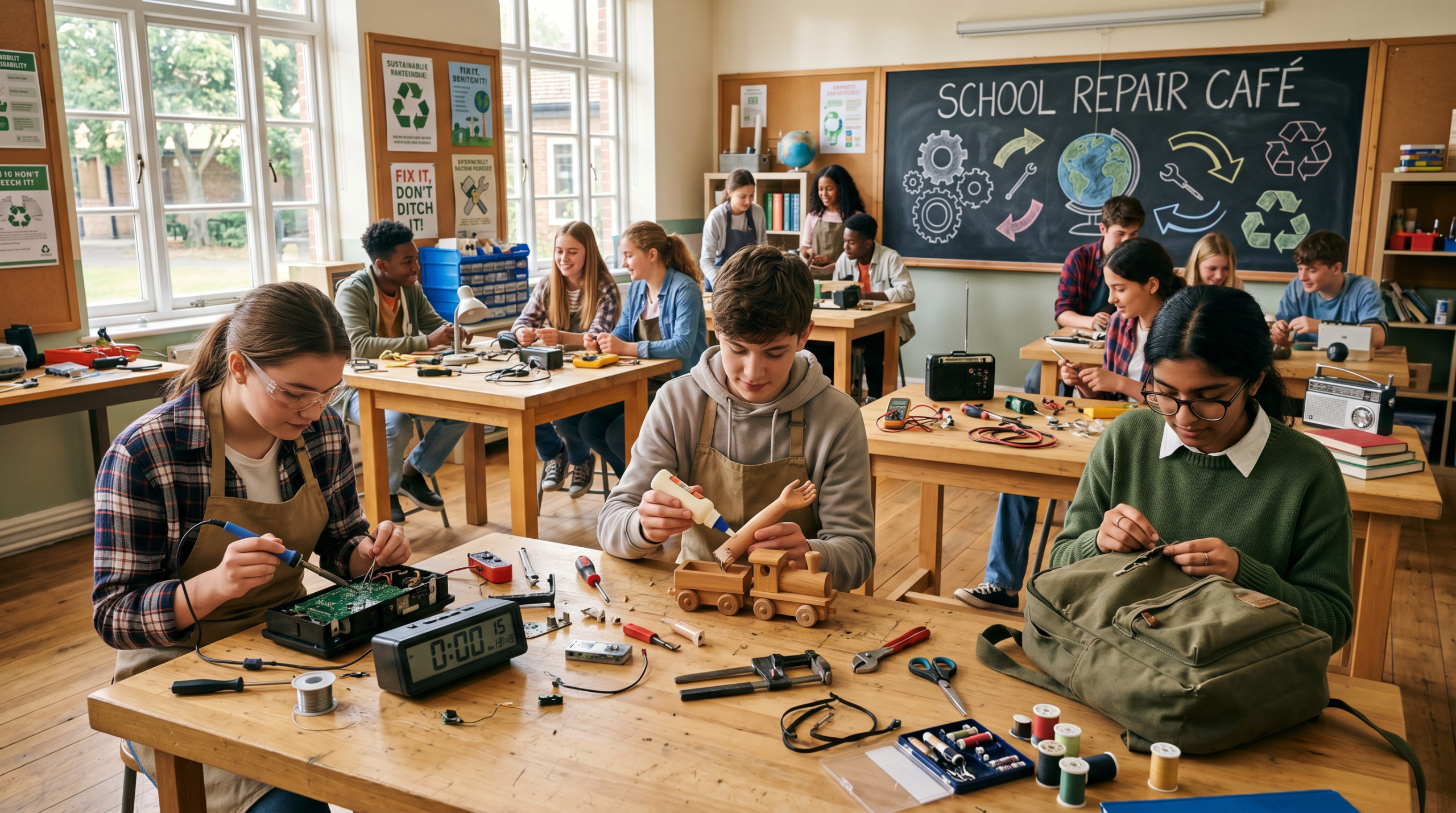
What a Repair Café Is
The concept is simple and powerful. A repair café is a free gathering where people bring broken belongings — small appliances, electronics, clothing, toys, furniture, bicycles — and work to repair them with the help of volunteers who have repair skills. The movement was founded by Martine Postma, who held the first event in Amsterdam in 2009 out of frustration with how readily usable things were being thrown out. The idea spread quickly because it answered a need people felt everywhere, and today repair cafés operate in dozens of countries, having collectively fixed hundreds of thousands of items that would otherwise have become trash.
In a school setting, the model adapts beautifully. A repair café can run as a club, a recurring event, or a unit woven into a class, with students taking on the role of fixers under guidance. The crucial feature, true to the original spirit, is that repairs are done together, with the owner watching and helping rather than handing the item over. The aim is not just to fix the object but to pass on the skill and the confidence — to help a young person believe that a broken thing is a puzzle to solve, not a verdict to accept. That shift in mindset is the whole point.
Craftsmanship: The Lost Art of Fixing
There was a time when knowing how to mend clothes, fix a leaky tap, or get an appliance working again was ordinary knowledge, passed down within families and communities. Those skills have quietly faded as products became cheaper to replace than to repair and as the know-how stopped being handed down. A school repair café revives them, and in doing so it cultivates craftsmanship — the patient, hands-on competence of someone who understands how things are made and how they can be restored.
Fixing a real object demands a rich blend of skills. Students learn to use tools properly and safely — screwdrivers, pliers, soldering irons, sewing needles — developing the fine motor control and tool sense that screens never build. They learn to take something apart carefully, keeping track of how it goes back together, which teaches organization and attention to detail. They learn that quality work cannot be rushed, that forcing a part breaks it, and that the difference between a clumsy fix and a clean one is patience and care. These are the values of craftsmanship, and they are deeply satisfying to acquire, because the reward is concrete: a thing that was broken now works, and you made it work.
The Craftsman’s Toolkit of Skills
Tool fluency. Using the right tool the right way — fine motor skill and safety.
Diagnosis. Figuring out why something failed before trying to fix it.
Patience. Careful, unhurried work — the heart of quality craftsmanship.
Understanding. Seeing how an object is built — and therefore how it works.
Perhaps the deepest craftsmanship lesson is that fixing requires understanding. You cannot repair what you do not comprehend, so a student forced to mend a toaster must first work out how a toaster actually functions — the heating element, the spring mechanism, the simple circuit. Repair is therefore a back door into engineering and physics, teaching how everyday machines work by taking them apart. In an age when most products are sealed black boxes, the act of opening one up and seeing the logic inside is genuinely demystifying. Students stop treating their possessions as magic and start seeing them as understandable, fixable systems.
Diagnosis as Detective Work
Before any repair comes diagnosis, and diagnosis is pure problem-solving. A device that won’t turn on could have a dozen causes — a frayed cord, a blown fuse, a loose connection, a dead component — and the fixer has to reason through them systematically. Students learn to observe symptoms carefully, form hypotheses about the cause, test those hypotheses one at a time, and narrow down to the real fault. This is the scientific method applied to a real object, with the satisfying feedback of either a working device or a clue that points to the next test.
Crucially, repair teaches that not every problem has a tidy solution. Sometimes the part is unavailable, the damage is too severe, or the fix would cost more than the object is worth, and students learn to make that judgment honestly. They also learn resilience — that a failed first attempt is normal, that you try another approach, and that some of the best fixes come after several dead ends. This tolerance for trial, error, and persistence is exactly the disposition that serves people well in engineering, in science, and in life. A repair café is, quietly, a course in not giving up.
Anti-Consumerism: Rethinking the Throwaway Economy
Beyond the hands-on skills, a repair café plants a powerful idea: that the constant cycle of buy-use-discard is a choice, not a law of nature. Students who fix things begin to see the throwaway economy clearly. They notice planned obsolescence — the way some products are designed to fail or become outdated so we’ll buy replacements — and they encounter the right-to-repair movement, which argues that people should be able to fix the things they own rather than being forced to replace them. These are not fringe concerns; they sit at the center of a growing global conversation about sustainability and consumer power, and repair cafés are widely seen as the grassroots heart of that movement.
The shift in mindset is subtle but profound. A student who has restored a broken object develops a different relationship with their belongings — they value them more, understand their cost in materials and labor, and feel less pressure to chase the newest version. The EPA itself, in its guidance on reducing and reusing, lists maintaining and repairing products as a key way to cut waste, precisely because a repaired item is one that doesn’t need to be manufactured anew. Repairing is reuse in its most active form, and it directly counters the disposability that drives so much waste.
The environmental stakes give this mindset real weight. Manufacturing new goods consumes enormous amounts of energy and raw materials, and discarded electronics in particular have become one of the world’s fastest-growing waste streams. When students grasp that the carbon and resources embedded in a single device are largely wasted if it’s tossed after one small failure, repairing stops being a quaint hobby and becomes an act of environmental responsibility. Anti-consumerism, in this light, is not about deprivation — it is about valuing what we already have enough to keep it working.
| Repair Activity | What It Teaches |
|---|---|
| Diagnosing the fault | Systematic problem-solving and the scientific method |
| Using tools | Craftsmanship, fine motor skills, and safety |
| Taking things apart | How machines work; engineering and physics |
| Choosing to fix | Anti-consumerism and environmental responsibility |
| Learning from a mentor | Intergenerational skill-sharing and community |
A Bridge Between Generations
One of the quietest gifts of a repair café is the human connection it creates. The repair skills that have faded from common knowledge still live in older generations — grandparents, retired tradespeople, hobbyists — and a school repair café invites them in as volunteer mentors. When a retired electrician shows a teenager how to test a circuit, or a grandmother teaches a child to darn a sock, something valuable passes between them that goes well beyond the repair itself. Knowledge moves down the generations again, as it once did naturally, and both sides benefit from the exchange.
This intergenerational, community dimension is part of what makes repair cafés so resilient and so beloved. They are sociable, low-pressure places where the emphasis is as much on the shared activity as on the outcome. For students, the experience of learning a real skill from a caring adult who is not their teacher or parent is rare and formative. It models a kind of community where people help each other, share what they know, and value contribution over consumption — a quietly radical alternative to a culture that often measures worth by what we buy.
How to Start a School Repair Café
Starting one is more approachable than it sounds. Begin with a single event: gather a few basic tools, recruit a handful of handy volunteers from among staff, parents, and the community, and invite students to bring in small broken items like toys, lamps, or clothing. Keep the first session simple and safe, focusing on low-risk repairs and ensuring proper supervision around tools and electricity. The international Repair Café organization offers starter guidance, and many local repair cafés are happy to advise a school getting started.
From there, the café can grow into a regular fixture — a monthly club, a recurring schoolwide event, or a thread running through a design-and-technology curriculum. Building in a few habits from the start helps: keeping a log of items fixed and waste diverted, celebrating successful repairs, and rotating students through roles from greeter to fixer to record-keeper. Treat the early sessions as experiments, learn what works for your community, and let the café become what every good repair makes possible: something built to last.
What Gets Fixed — and What Each Repair Teaches
Part of what makes a repair café so rich is the sheer variety of items that come through it, each calling on different skills. Clothing and textiles — a torn seam, a stuck zipper, a missing button — teach sewing, fine handwork, and the basics of how garments are constructed. Small electricals and electronics, from lamps to radios, introduce circuits, connections, and the logic of how powered devices work. Bicycles are a mechanical classroom of gears, brakes, and tension. Wooden furniture and toys bring in basic carpentry, gluing, and joinery, while jewelry, crockery, and household gadgets each demand their own careful technique.
This range is a strength, because it lets every student find an entry point that matches their interest and confidence, then stretch from there. A student who arrives comfortable with a needle and thread may end the term peering inside a toaster; one fascinated by electronics may discover the satisfaction of mending a beloved stuffed animal. The breadth also reinforces the central message: almost anything we own can, with knowledge and care, be kept in use longer. Whatever the object, the underlying lessons repeat — observe, understand, attempt, and persist — and they compound across every different thing a student learns to fix.
Frequently Asked Questions
Isn’t it dangerous to have students repairing electronics?
With proper supervision and sensible limits, it’s safe. Schools focus on low-risk repairs — clothing, toys, simple mechanical items — and have skilled adult volunteers handle or guide anything involving mains electricity, following safety rules throughout.
What if an item can’t be fixed?
That’s a valuable outcome too. Students learn to assess whether a repair is feasible and worthwhile, and even an unsuccessful attempt teaches diagnosis, persistence, and how the object works — while keeping it out of the landfill a little longer.
How does this connect to the curriculum?
Repair touches science and engineering (how things work), design and technology (making and fixing), math (measuring and costing), and social studies (consumerism, sustainability, and the right-to-repair movement) — a naturally cross-curricular activity.
Fix It, Don’t Pitch It
A school repair café is a workshop, a science lab, and a quiet act of rebellion all at once. It hands students real tools and real problems, builds the craftsmanship our throwaway culture let slip, and shows them that a broken object is an invitation to understand and restore rather than discard and replace.
Start with one event, a few tools, and a couple of patient mentors. Let students feel the deep satisfaction of bringing something back to life — and watch them carry that confidence, and that resistance to disposability, far beyond the workbench. In a world built to be thrown away, learning to fix is a kind of freedom.
A thing worth owning is a thing worth fixing.
This article is for general educational purposes. For more on the movement, see Repair Café International and its About page, and the U.S. EPA’s Reducing and Reusing Basics. Always supervise students around tools and electrical equipment and follow proper safety procedures.
Leave a Reply