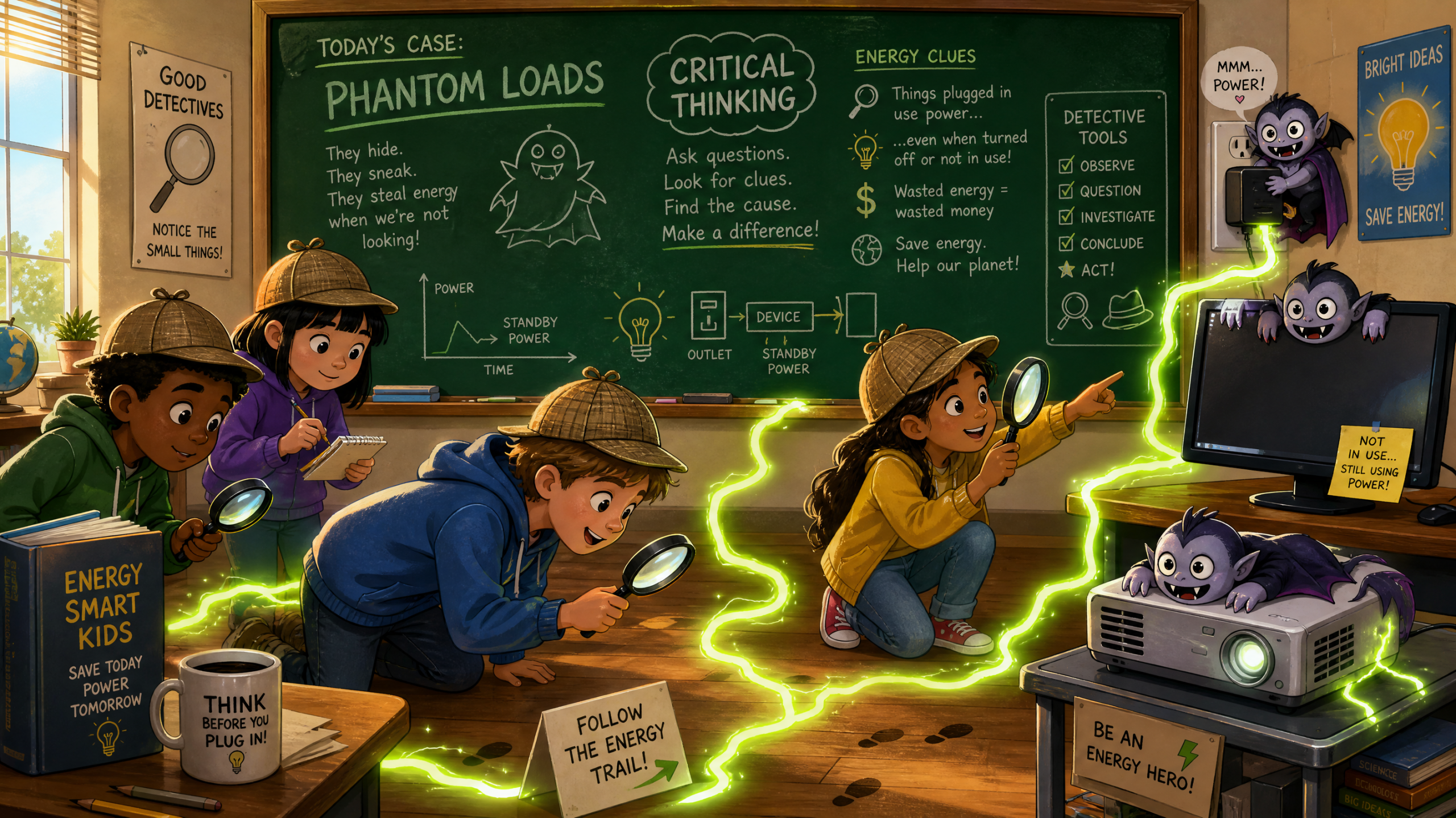
Phantom Loads and Power Vampires: How Investigating School Energy Waste Builds Critical Thinking
The Invisible Problem
Start with a claim that sounds wrong: many of the things you turn off are not actually off. A monitor on standby, a printer waiting for a job, a phone charger with nothing attached, the microwave clock glowing in the staff room — all of them sip electricity around the clock. The Lawrence Berkeley National Laboratory, which studies this for a living, describes standby power as the electricity a device consumes when it is switched off or not doing its main job. Most individual devices draw less than half a watt, but a building holds dozens of them, and they never stop.
The scale is where it stops being trivia. The Department of Energy estimates standby power costs the average U.S. household as much as $100 a year, and that nationally these always-on devices waste well over 100 billion kilowatt-hours of electricity annually. A school, with its hundreds of computers, projectors, and appliances, is a far larger version of the same problem. The first thing a student confronts is therefore a genuine puzzle: a cost this big should be obvious, so why can’t anyone see it? The answer — because it hides in plain sight, a trickle rather than a flood — is itself a lesson in how real problems often disguise themselves.
Becoming a Detective
You cannot argue with a phantom; you have to catch it. The tool is a cheap plug-in watt meter — a “Kill A Watt” is the common name — that sits between a device and the outlet and reports exactly how much power is flowing, even when the device is “off.” Armed with one, students walk the school as investigators, plugging the meter into one suspect after another and writing down what they find. The vending machine that runs all night, the cluster of classroom computers asleep but not off, the laminator no one has used in weeks: each gets measured, and each surrenders a number that was invisible a moment before.
Then comes the math that turns a reading into a meaning — and it is beautifully simple. A device drawing one watt continuously for a full year uses about nine kilowatt-hours, as Berkeley’s researchers spell out. So a projector idling at five watts quietly burns roughly 45 kilowatt-hours a year doing nothing; multiply by every projector in the building and the “trivial” number stops being trivial. Students learn to convert watts into annual energy into dollars, and in doing so they discover one of the most important moves in all of quantitative reasoning: a single small number means little until you multiply it by how often, how many, and how long.
What the Meter Forces You to Ask
Is “off” really off? The reading often isn’t zero — the assumption was wrong.
How small is too small to matter? One watt seems nothing — until you count the watts and the hours.
Necessary or wasteful? A fridge must stay on; a weekend printer need not. Telling them apart is the real skill.
Where’s the biggest win? Not every vampire is worth chasing — the data shows which ones are.
Why This Builds Critical Thinking, Specifically
Plenty of projects keep students busy; this one trains the particular habits that define a careful thinker. The first is questioning an assumption everyone shares. “Off means off” is so obvious nobody states it — and it is false. A student who has personally measured a device drawing power while switched off has felt, not just been told, that the obvious can be wrong, and that the way to find out is to check rather than assume. That instinct — test the claim, don’t trust it — is the engine of critical thought.
The second habit is distinguishing the necessary from the wasteful, which forces real judgment rather than a blanket rule. Not all standby power is bad: a refrigerator must keep running, a fire alarm must stay alert, a clock must keep time. The goal is not to unplug everything but to separate the standby that earns its keep from the standby that doesn’t — a nuanced call that resists the simple slogan “unplug it all.” Students also confront scale and aggregation, learning why a problem made of thousands of tiny pieces feels minor at every single point yet is enormous in total, a reasoning trap that shows up everywhere from budgets to climate to public health.
From Suspicion to Evidence to Action
A good investigation does not end with a list of culprits; it ends with a recommendation backed by evidence. Once students have measured and tallied the building’s phantom loads, they can prioritize — tackle the biggest, cheapest wins first — and propose specific fixes. A smart power strip can cut a whole cluster of devices to true zero with one switch; a scheduling rule can power down computer labs over breaks; guidance from ENERGY STAR confirms that fully disconnecting equipment is what actually eliminates standby draw. Berkeley’s researchers note that an informed, aggressive approach can cut standby use by roughly a fifth — a concrete target students can aim at.
The most rigorous version closes the loop with proof. The class measures a cluster’s phantom load, installs a switched strip or a shut-down schedule, and measures again — demonstrating, with before-and-after numbers, that their fix worked. This is the difference between believing something and showing it, and it is the heart of evidence-based reasoning. Free resources from programs like the EIA’s Energy Kids help frame the project so students move deliberately from suspicion, to measurement, to a conclusion they can defend.
| Investigation Step | Critical-Thinking Skill It Builds |
|---|---|
| Doubting “off means off” | Questioning shared assumptions instead of accepting them |
| Measuring with a watt meter | Replacing guesses with evidence; trusting data over intuition |
| Watts → kWh → dollars | Reasoning about scale, aggregation, and units |
| Necessary vs. wasteful load | Nuanced judgment that resists oversimple rules |
| Measure, fix, measure again | Testing a hypothesis and proving cause and effect |
The Bigger Lesson
The reason phantom loads make such a good teacher is that the thinking they demand is the same thinking serious problems demand everywhere. A great many costly issues — in money, in health, in the environment — are invisible, counterintuitive, and made of small pieces that only matter in aggregate. A student who has learned to suspect the obvious, reach for a measurement, do the multiplication, and prove a fix with before-and-after data has built a toolkit that works on far more than a vending machine.
That is the quiet gift of the power-vampire hunt. It looks like an energy project, and it does save the school real money. But underneath, it is a course in skepticism done right: not cynicism, not doubting everything, but the disciplined habit of checking a claim against the world before believing it. Catch a few phantoms with a watt meter, and a student starts to wonder what else they have been assuming without measuring — which is exactly the question we most want them to ask.
Catch the Vampire, Learn to Think
Phantom loads are the perfect problem for a young mind because they punish the lazy assumption and reward the patient measurement. “Off” turns out not to mean off; a watt turns out not to be nothing; a tiny waste turns out, multiplied across a building and a year, to cost real money. Every one of those reversals is a small lesson in thinking carefully instead of quickly.
For a school, the investigation costs almost nothing — one inexpensive meter and a willingness to wander the halls asking “is this really off?” — and it pays twice: in the energy waste it eliminates, and in the critical thinking it builds. Hand a student the meter and let them prove you wrong. The habit of mind they take away will outlast every kilowatt-hour they save.
Don’t assume it’s off. Measure it.
This article is for general educational purposes. For authoritative information on standby power and energy saving, see the U.S. Department of Energy, Lawrence Berkeley National Laboratory’s Standby Power project, ENERGY STAR, and the U.S. EIA’s Energy Kids program. Supervise students around electrical outlets and equipment.
Leave a Reply