Native, Non-Native, Invasive: The Crucial Distinctions
The first thing a restoration project teaches is that the words matter, and they are not interchangeable. A native species is one that occurs naturally in a region, having evolved there over a long time as part of the local web of life. A non-native species (also called introduced or exotic) is one brought into an area where it doesn’t naturally occur, whether deliberately or by accident. Crucially, not every non-native species causes harm — many garden plants and crops are non-native and perfectly well-behaved. An invasive species is the dangerous subset: a non-native that spreads aggressively and causes economic harm, environmental harm, or harm to human health.
Getting these definitions straight is itself a valuable exercise in precision, because the popular conversation often blurs them. Students learn, for instance, that “non-native” and “invasive” are not synonyms — that, as the U.S. Geological Survey notes, only a small fraction of introduced species become truly invasive. They learn that the federal definition of “invasive” hinges on harm, not merely on origin. This care with categories teaches a habit of precise thinking that underlies all good science: before you can solve a problem, you have to define your terms exactly and resist sloppy generalizations.
Why Invasive Species Are a Real Problem
Understanding why invasive species matter gives a restoration project its purpose and urgency. When an organism is moved to a new place without the predators, diseases, and competitors that kept it in check back home, it can spread unchecked — outcompeting native species for space, light, water, and nutrients, and disrupting the relationships that hold an ecosystem together. The USGS reports that more than 6,500 non-native species are now established in the United States, and the damage they do is enormous. Familiar examples like kudzu smothering forests, zebra mussels clogging waterways, and Burmese pythons reshaping the Everglades make the threat vivid.
The harm is ecological and economic at once, which lets students see how the two connect. The National Invasive Species Information Center documents how invasives damage crops, forests, fisheries, and infrastructure, costing billions and threatening livelihoods. They also reduce biodiversity, sometimes driving native species toward extinction by taking over their habitat or eating them directly. When students grasp that a single aggressive plant or animal can unravel an entire local ecosystem — and cost a society dearly — the work of removing invasives and restoring natives stops feeling like gardening and starts feeling like a meaningful intervention in a real problem. That sense of purpose powers the whole project.
Telling Them Apart
Native: Belongs here; evolved as part of the local ecosystem; supports it.
Non-native: Introduced from elsewhere — but often harmless and well-behaved.
Invasive: Non-native and harmful — spreads aggressively and damages the ecosystem.
The judgment: Deciding which is which — carefully, with evidence — is the real skill.
Research Skills: Becoming a Field Investigator
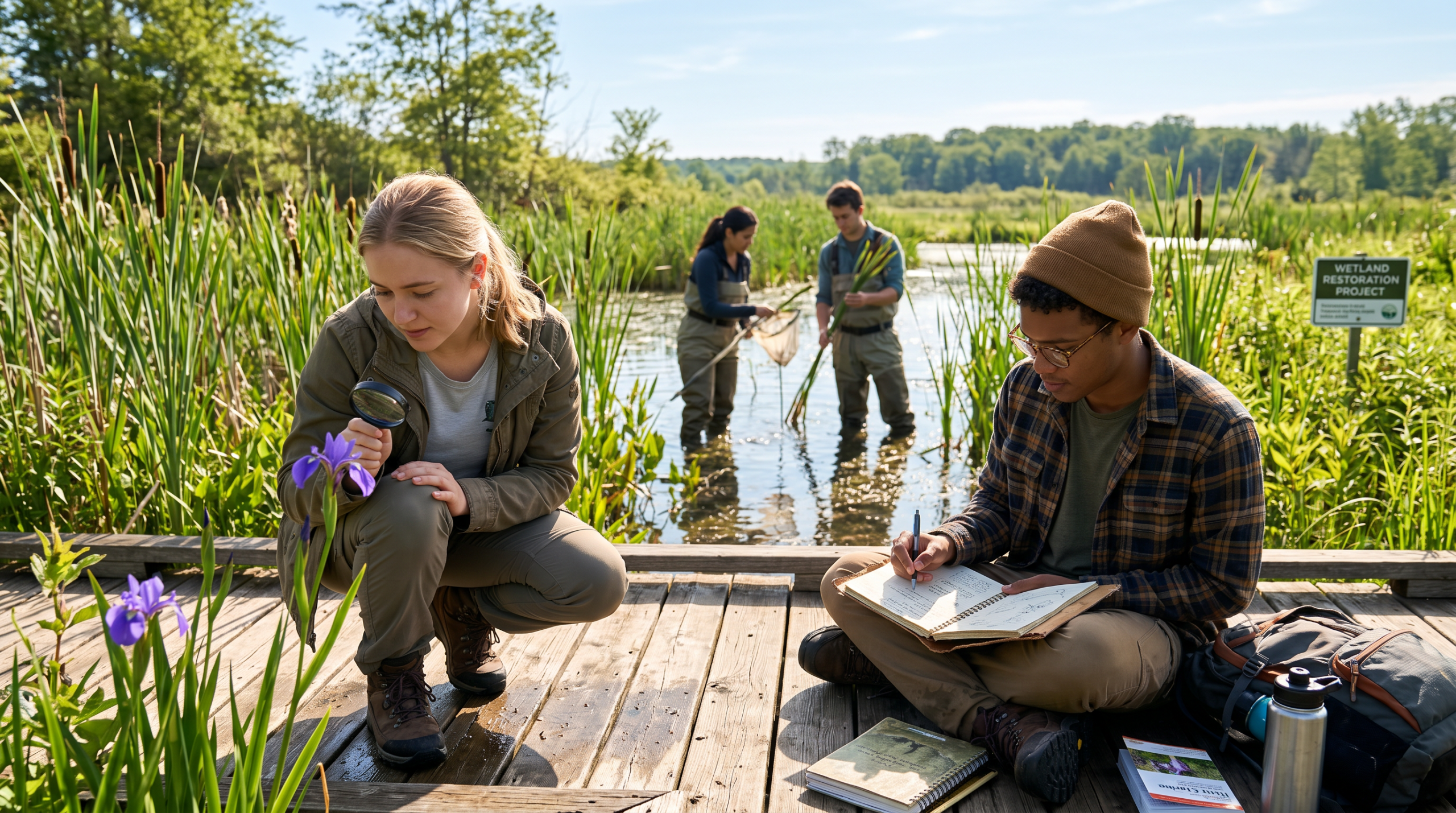
A restoration project cannot begin until students know what they’re working with, and finding that out is a serious research exercise. They must identify the species present in their site — which plants are growing there, and which are native, non-native, or invasive in their particular region. This is harder than it sounds, because the answer is local: a plant that is native in one region may be invasive in another, so students cannot rely on a single universal list. They learn to consult authoritative sources, regional databases, and field guides, and to cross-check information rather than trusting the first thing they find.
This investigation builds genuine research literacy. Students learn to evaluate the reliability of sources, favoring government agencies, universities, and conservation organizations over random websites. They learn to gather evidence about each species — its origin, its behavior, its impact — and to assemble a clear picture before acting. They practice careful observation in the field, documenting what grows where, and they may research the history of their site to understand how it came to be the way it is. These are the same information-gathering and source-evaluation skills that underpin scholarship in every discipline, and a restoration project teaches them in service of a decision that actually matters.
The research also extends to the solution. Once students know which invasives to remove, they must investigate how to remove them responsibly — some plants resprout from roots, some spread seeds when disturbed, some require specific timing — and which native species to plant in their place. They research what grew there historically, what supports local wildlife, and what will thrive in the site’s conditions. This is applied research with real consequences: a poorly chosen method can spread the very invasive you meant to remove, and a poorly chosen replacement can fail or cause new problems. Students learn that good action depends on good research done first.
Ecological Judgment: Weighing Hard Trade-Offs
Here is where a restoration project becomes genuinely sophisticated. Beyond identification and research lies judgment — the ability to weigh competing considerations and make a reasoned decision under uncertainty. Restoration is full of these judgment calls, and they rarely have a clean, textbook answer. Should you remove an invasive that is currently providing cover or food for some native animals, knowing the disruption it causes overall? How do you prioritize when resources are limited and the invasives are many? Is a particular non-native actually causing harm, or is it benign enough to leave alone?
Wrestling with these questions teaches students that ecology is not a set of simple rules but a web of trade-offs, where actions have ripple effects and certainty is rare. They learn to consider consequences before acting — to ask what might happen if they remove a plant, what could fill the gap it leaves, and whether the cure might be worse than the disease. They learn humility, recognizing that ecosystems are complex enough to surprise us and that careful, reversible, well-observed steps beat bold, irreversible ones. This kind of judgment — reasoning carefully under uncertainty, weighing competing goods, anticipating consequences — is among the most valuable and most difficult skills a person can develop, and it applies to far more than ecology. It is the same skill a doctor uses in weighing a treatment, an engineer uses in balancing a design, and a citizen uses in evaluating a policy: the disciplined art of deciding well when the answer is not simply given. A restoration project is a rare chance to practice it on a problem where the stakes are real but the mistakes are recoverable.
Importantly, the project also teaches that judgment must be paired with action and observation. Students don’t just deliberate; they make a decision, carry it out, and then monitor the results — watching whether the natives establish, whether the invasives return, whether the wildlife responds. This feedback loop closes the gap between deciding and learning, showing students that ecological judgment improves through experience and observation, not through certainty in advance. They learn to treat their restoration as an ongoing experiment, adjusting their approach as the land responds — the mature, evidence-driven mindset of a real conservation scientist.
| Restoration Phase | The Skill It Builds |
|---|---|
| Identifying species | Precise classification; native vs. non-native vs. invasive |
| Researching the site | Source evaluation, evidence-gathering, research literacy |
| Deciding what to do | Ecological judgment; weighing trade-offs under uncertainty |
| Removing & replanting | Responsible method, anticipating consequences |
| Monitoring results | Long-term observation; treating action as experiment |
A Cross-Disciplinary, Real-World Project
A restoration project naturally draws together many subjects, which is part of what makes it such efficient learning. It is rooted in biology and ecology, of course, but it also calls on geography as students consider how species spread across regions and why a plant native to one place became invasive in another. It involves history, since many invasions trace back to human movement of plants and animals across the globe. It uses data and math as students map their site, measure plots, count plants, and track change over time. And it touches civics and ethics as students confront questions about human responsibility for ecosystems and how communities make decisions about shared land.
The project is also deeply real, with outcomes that persist beyond the classroom. Students transform an actual piece of land, and the natives they plant and the invasives they remove make a lasting difference to local wildlife and ecosystem health. Many schools partner with parks, nature centers, or conservation groups — the kinds of organizations that lead restoration work documented by agencies like the USDA — giving students authentic experience alongside professionals. The combination of intellectual rigor, hands-on labor, and genuine impact makes restoration one of the most complete educational experiences a school can offer, engaging head, hands, and heart at once.
How to Start a Restoration Project
Begin small and informed. Choose a manageable site — a corner of the schoolyard, a strip along a fence, a neglected bed — and start with research before any removal: identify what’s growing there and determine, using authoritative regional sources, which species are native, non-native, or invasive. Partnering with a local conservation group, park, or extension office is enormously helpful, providing expertise on what to remove, how to remove it safely, and which native plants suit your area. This guidance prevents the common beginner mistakes of misidentifying a species or removing an invasive in a way that spreads it.
From there, treat the work as an ongoing, observed experiment rather than a one-time cleanup. Plant natives, document the before-and-after, and return regularly to monitor whether the restoration is succeeding and whether invasives are creeping back. Assigning roles — researchers, mappers, planters, monitors — spreads ownership and mirrors how real restoration teams operate. Keep records, take photos over time, and let students see the land slowly heal as their natives take hold. Restoration rewards patience and persistence, and a project that returns season after season teaches students that caring for a landscape, like all worthwhile stewardship, is a long-term commitment rather than a single afternoon’s work.
Frequently Asked Questions
Are all non-native plants bad?
No. Many non-native plants, including most garden flowers and food crops, are harmless. Only the small fraction that spread aggressively and damage ecosystems, the economy, or health are considered invasive. Learning to tell the difference is a core part of the project.
How do students know which plants are invasive in their area?
By consulting authoritative regional sources — government agencies, universities, and conservation groups — since a species’ status varies by location. Cross-checking reliable sources and, ideally, partnering with a local expert is the way to be sure before removing anything.
Is removing invasive plants safe for students?
With guidance, yes. Schools focus on manageable, hand-removable plants, learn proper techniques to avoid spreading them, and partner with experts for anything difficult. Wearing gloves, identifying plants correctly, and following local advice keeps the work safe.
Heal the Land, Train the Mind
A native-versus-invasive restoration project asks students to do what real scientists do: define their terms precisely, research carefully, weigh hard trade-offs, act responsibly, and watch the results. It turns a neglected patch of ground into a living classroom for research skills and ecological judgment — the rare ability to reason well under uncertainty about a complex system.
Start with a small site, solid research, and a local partner, then treat the work as an experiment you observe over time. Students will leave having genuinely improved a piece of the living world — and having practiced the careful, evidence-based judgment that good stewardship, and good thinking, always require.
Know before you pull — restoration begins with research.
This article is for general educational purposes. For authoritative information, see the USDA, the National Invasive Species Information Center, the U.S. Geological Survey, and the Department of the Interior. Always identify plants correctly and follow local guidance before removing any species.
Leave a Reply