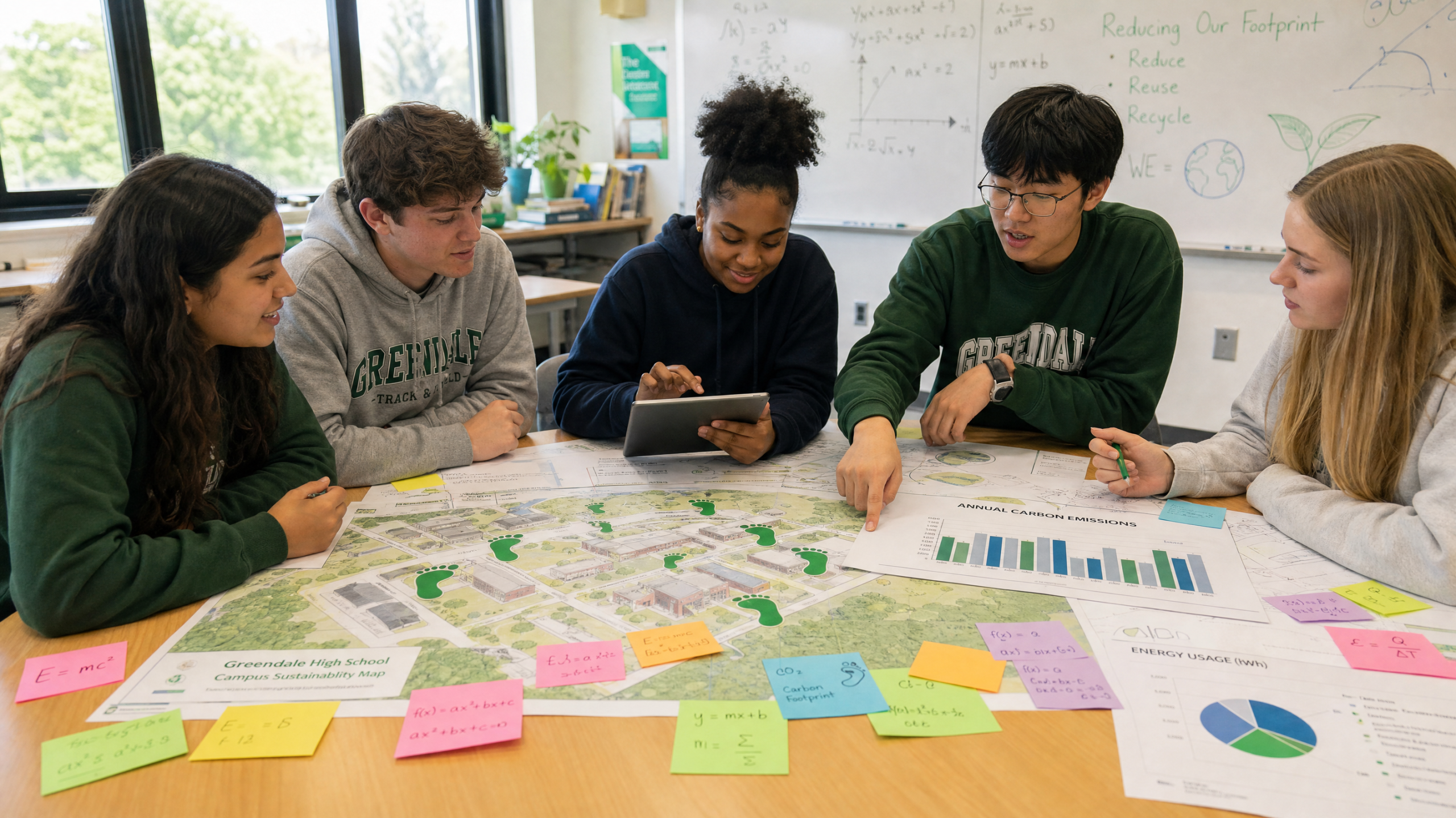
What a Carbon Footprint Is
A carbon footprint is the total amount of greenhouse gases that a person, organization, or activity is responsible for releasing, usually expressed in units of carbon dioxide. For a school, that footprint comes from several sources: the electricity that lights and powers the building, the fuel burned for heating, the buses and vehicles that bring students and staff, and the waste the school sends to landfills. Each of these activities releases greenhouse gases, and a carbon footprint project adds them all up into a single, comprehensible total. The EPA’s household and organizational tools organize this into clear categories — energy, transportation, and waste — that map neatly onto a school’s operations.
The first conceptual hurdle, and a genuinely educational one, is that different greenhouse gases have different warming effects, so they are converted to a common unit: carbon dioxide equivalent, written CO2e. This lets a school combine carbon dioxide from electricity, methane from waste, and other gases into one comparable figure. Students learn that methane, for instance, traps far more heat per ton than carbon dioxide does — its global warming potential is many times higher — which is why a small amount of it counts for a lot. Grasping that gases can be measured against a common standard is a real scientific and mathematical idea, and it underpins everything that follows.
Math With a Purpose
A carbon footprint project is, fundamentally, a mathematics project — and one with a motivating purpose that ordinary word problems lack. The core operation is conversion: turning real-world activity data into emissions using conversion factors. Students take the school’s electricity use in kilowatt-hours and multiply by an emissions factor to get tons of carbon dioxide; they take the gallons of fuel burned, or the miles driven by buses, or the tons of waste sent to landfill, and convert each into its carbon equivalent. This is multiplication, unit conversion, and dimensional analysis applied to genuine numbers the students gathered themselves, which makes the math feel real rather than arbitrary.
The project naturally exercises a wide range of mathematical skills. Students work with large numbers and learn to keep units straight across conversions — a discipline that trips up even professionals. They calculate proportions and percentages, figuring out what share of the footprint comes from electricity versus transport versus waste. They handle rates, like emissions per student or per square foot, which let them compare fairly across time or against other schools. They build charts and graphs to display the breakdown, practicing data visualization. And because real data is messy and incomplete, they grapple with estimation and assumptions, learning to make reasonable approximations and to be honest about the uncertainty in their results. This is rich, applied mathematics, and students see exactly why each skill matters because each one answers a real question about their own school.
The Footprint Equation
Energy: kilowatt-hours & fuel × emission factors = tons CO2e
Transportation: miles driven & fuel burned × factors = tons CO2e
Waste: tons to landfill × factors = tons CO2e
Total footprint = the sum — the school’s whole climate impact in one number
Making Big Numbers Mean Something
One of the most valuable mathematical lessons in a carbon project is learning to make an abstract number meaningful. “The school emits several hundred tons of carbon dioxide a year” is hard to picture — tons of an invisible gas mean little to anyone. This is where equivalencies come in. The EPA’s Greenhouse Gas Equivalencies Calculator translates emissions into concrete, relatable terms: a given quantity of carbon dioxide becomes the equivalent of so many cars driven for a year, so many homes’ annual electricity, or the number of tree seedlings that would need to grow for a decade to absorb it. Students learn that one passenger car emits roughly several tons of CO2e per year, giving them a yardstick to make sense of their school’s total.
Translating numbers into meaningful comparisons is a genuine quantitative-reasoning skill, and a transferable one. Students learn that a number alone often communicates nothing, and that good analysts make data understandable by relating it to things people already grasp. They practice scaling and proportion as they convert their footprint into cars or homes or trees, and they discover the rhetorical power of a well-chosen comparison — how “equal to taking forty cars off the road” lands far harder than a bare figure in tons. This ability to make numbers vivid and comprehensible is exactly what distinguishes a confusing report from a persuasive one, in science, business, and public life alike.
Accountability: Owning the Number
Beyond the math, a carbon footprint project teaches accountability — the practice of measuring your impact, owning it, and taking responsibility for changing it. The very act of measurement is the foundation of accountability: you cannot be answerable for what you refuse to count. When students put a real number on their school’s emissions, the impact stops being a vague abstraction and becomes a concrete fact they now know and cannot un-know. That knowledge carries a quiet moral weight — not guilt, but responsibility — and it transforms students from passive occupants of the building into people who understand and can answer for its impact.
Accountability becomes active when students use the footprint to drive change. Because the project breaks the total down by source, it points directly to where action would help most: if electricity dominates the footprint, that’s where to focus; if transportation is large, that’s the lever to pull. Students can propose reductions — efficiency upgrades, behavior changes, waste diversion, cleaner transport — estimate their impact using the same math, implement them, and then re-measure to see if the number actually dropped. This closes the loop between measuring and improving, teaching students that accountability is not a one-time confession but an ongoing cycle of measure, act, and verify. They learn, concretely, that responsibility is something you can quantify, track, and prove — a lesson that applies to far more than carbon.
| Project Step | What It Teaches |
|---|---|
| Gathering activity data | Real-world data collection from bills and records |
| Converting to CO2e | Unit conversion, multiplication, dimensional analysis |
| Breaking down by source | Proportions, percentages, and data visualization |
| Using equivalencies | Making big numbers meaningful; quantitative reasoning |
| Acting & re-measuring | Accountability; the measure–act–verify cycle |
A Project That Touches Many Subjects
A carbon footprint project is naturally interdisciplinary, which is part of what makes it such efficient learning. It is grounded in mathematics — the conversions, proportions, and calculations at its core — and in science, as students learn what greenhouse gases are, how they trap heat, and why different gases warm the planet to different degrees. It draws on data and technology as students collect figures, build spreadsheets, and create visualizations. And it reaches into civics and economics as students consider who is responsible for emissions, what reductions cost and save, and how an institution makes decisions about its impact.
The project is also authentically real, with results that can genuinely matter to the school. A well-done carbon footprint can inform actual decisions about energy upgrades, transportation, and waste — the same kind of measurement that companies and governments now perform routinely under frameworks that track emissions across direct operations, purchased energy, and supply chains. Students learn that carbon accounting is a real and growing professional discipline, and that the skills they’re practicing — measuring, converting, analyzing, and reporting environmental impact — are exactly the ones a fast-expanding field of sustainability work demands. The school’s footprint becomes both a math lesson and a glimpse of meaningful real-world work.
How to Run a Footprint Project
Start by scoping the project to what’s manageable. A class might begin with just one category — electricity, say — gathering the school’s usage from utility bills and converting it to emissions before tackling transportation and waste. Free tools from the EPA do much of the conversion math, letting students focus on gathering accurate activity data and interpreting the results, though more advanced classes can work the conversion factors by hand for the full mathematical experience. Beginning with a single, well-documented category builds confidence and produces cleaner numbers than trying to capture everything at once.
From there, treat the footprint as a living measurement rather than a one-time calculation. Once students have a baseline, they can propose and model reductions, implement a change, and re-measure to verify the effect — turning the project into an ongoing cycle that teaches accountability through repetition. Assigning roles (data gatherers, calculators, analysts, reporters) spreads the work and mirrors how real sustainability teams operate, and sharing results with school leadership gives the project genuine stakes. Keep records year over year, and the footprint becomes a long-running dataset that documents the school’s progress — concrete proof that careful measurement, honest accountability, and a little applied math can add up to real change.
Comparing, Benchmarking, and Goal-Setting
A single footprint number is informative, but comparison is what turns it into insight — and the math of comparison teaches its own valuable lessons. To compare fairly, students must normalize the data, dividing the total by something like the number of students or the building’s floor area to get emissions per person or per square foot. They quickly discover why this matters: a large school will always have a bigger total footprint than a small one, so only a normalized figure reveals which is actually more efficient. This is the same “compared to what?” reasoning that underlies all sound use of statistics, learned here through a number students gathered themselves.
Comparison also makes goal-setting concrete and mathematical. Once students can express their footprint as a per-student rate, they can set a target — say, a ten percent reduction — and calculate exactly what that means in tons and in specific actions. They can track progress against the goal over months or years, computing percent change and plotting the trend, which keeps accountability alive long after the first calculation. They learn that a goal without a number is just a wish, and that measurement is what makes improvement provable. Setting a quantified target, working toward it, and verifying the result with math is precisely how real organizations manage their emissions — and how students learn that responsibility and arithmetic are partners.
Frequently Asked Questions
What data does a school carbon footprint require?
Mainly activity data: electricity and heating-fuel use from utility bills, fuel or mileage for buses and vehicles, and the amount of waste sent to landfill. These are converted into emissions using standard factors from tools like the EPA’s calculators.
Is the math too hard for younger students?
No — it scales. Younger students can use online calculators and focus on interpreting and comparing results, while older students can work the unit conversions and emission factors by hand for a deeper mathematical challenge.
What is CO2e, and why use it?
CO2e (carbon dioxide equivalent) is a common unit that lets different greenhouse gases be combined and compared based on their warming effect. It allows a school to add up emissions from electricity, waste, and transport into one meaningful total.
Count It to Change It
Mapping a school’s carbon footprint turns an invisible impact into a number students can calculate, understand, and act on. Along the way it delivers a wealth of applied mathematics — conversions, proportions, rates, and the art of making big numbers meaningful — all in service of a question students genuinely care about.
More than math, it teaches accountability: the discipline of measuring your impact, owning it, acting on it, and proving the change with the same numbers. Start with one category, build the baseline, and let students complete the measure–act–verify loop. They’ll learn that responsibility, like any good measurement, begins with the courage to count.
You can’t manage what you don’t measure — so measure it.
This article is for general educational purposes. For measurement tools, see the EPA’s Carbon Footprint Calculator, its Greenhouse Gas Equivalencies Calculator, and the calculator’s calculations and references. Figures are estimates; use current factors for accuracy.
Leave a Reply