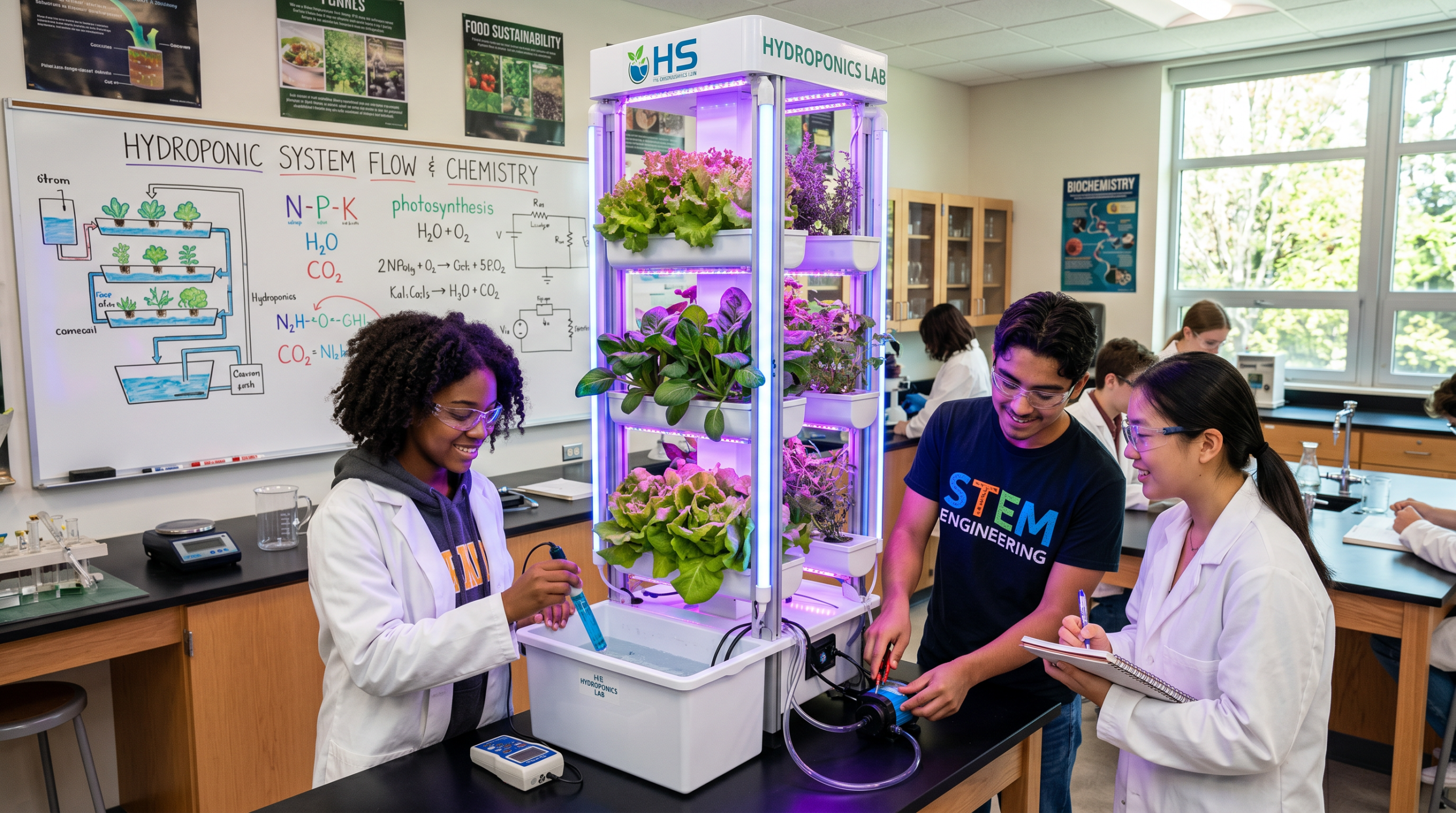
Growing Without Soil: What Hydroponics Actually Is
The word hydroponics comes from the Greek roots for “water” and “labor,” and that captures the idea perfectly: it is gardening done through water rather than soil. In a conventional garden, soil serves two functions — it anchors the plant and it holds the nutrients the roots absorb. Hydroponics simply separates those jobs. The plant is anchored by an inert material like a small sponge, clay pebbles, or a foam collar, and the nutrients are delivered directly in a water-based solution. Strip away the soil, and you can see exactly what a plant needs to live: light, air, water, support, and a precise menu of dissolved minerals.
This is not a new or fringe idea. As National Agriculture in the Classroom notes, the principles behind hydroponics are ancient, and the technique was used during World War II to grow fresh produce for troops stationed on islands with no arable soil. Today it powers commercial vertical farms, greenhouses, and even experiments aboard the International Space Station. For a classroom, that real-world relevance is a gift: students aren’t doing a toy exercise but a scaled-down version of genuine, cutting-edge agriculture. And because the system is transparent and controllable, it turns the invisible needs of a plant into visible, measurable variables.
The Chemistry: A Plant’s Diet, Dissolved in Water
In soil, the chemistry of plant nutrition is hidden and buffered — the soil quietly stores and releases nutrients, masking what’s really happening. Hydroponics removes that veil and puts the chemistry directly in students’ hands. To grow a healthy plant in water, you have to provide every nutrient yourself, in the right amounts and the right form, which makes the nutrient solution a genuine chemistry problem. Students learn that plants require macronutrients in larger quantities — nitrogen, phosphorus, and potassium chief among them — along with calcium, magnesium, and sulfur, plus a set of micronutrients like iron, zinc, and manganese needed only in trace amounts but essential all the same.
These nutrients dissolve into water as ions, and managing them introduces real analytical chemistry. Two measurements become the heartbeat of a hydroponic system. The first is pH — the acidity of the solution — which must usually sit in a slightly acidic range, because outside it the plant simply cannot absorb certain nutrients no matter how plentiful they are. Students test pH regularly and adjust it, watching how the number drifts as plants take up minerals. The second is electrical conductivity (often read as EC or as parts per million), which measures how concentrated the dissolved nutrients are, since a solution full of dissolved salts conducts electricity better than pure water. Together these two numbers tell a student whether their plants are being fed correctly — a continuous, data-rich chemistry experiment running every single day.
Key Measurements
pH (acidity): Controls whether nutrients can be absorbed at all. Test and adjust regularly.
EC / PPM (concentration): Measures how much nutrient is dissolved — too little starves, too much burns.
Macronutrients: Nitrogen, phosphorus, potassium and more, needed in larger amounts.
Micronutrients: Iron, zinc, manganese and others — tiny amounts, essential roles.
The payoff of all this measurement is diagnostic power. When a plant’s leaves yellow or its growth stalls, students become nutrient detectives: is it a pH problem locking out iron, a nitrogen shortage, or too concentrated a solution? They learn to read a plant’s symptoms, form a hypothesis, test the solution, and correct it — then watch whether the plant recovers. This is the scientific method applied to living chemistry, with feedback measured in days. Few exercises connect the abstract periodic-table world of elements to a visible, growing outcome so directly.
The Engineering: Building the System
A hydroponic setup doesn’t run itself — someone has to design and build the machine that delivers water, nutrients, oxygen, and light in the right way. That makes hydroponics an engineering project as much as a biology one. Students confront a menu of system designs, each with its own logic and trade-offs. A wick system is the simplest, drawing solution up to the roots passively with no moving parts. Deep water culture suspends roots directly in an aerated reservoir. The nutrient film technique flows a thin stream of solution past the roots in channels. An ebb-and-flow system floods and drains the roots on a timer. Choosing among them is a real design decision based on cost, complexity, the crop, and the space available.
Building any of these forces students to solve concrete engineering problems. Roots need oxygen, so most systems require an air pump and air stone — and students quickly learn that roots sitting in still water without aeration will drown and rot. Indoor systems need light, which opens a lesson in the spectrum and intensity plants require and why specialized grow lights are tuned the way they are. Pumps must be sized, reservoirs must be sealed against leaks, and timers must be programmed. When something fails — a clogged line, a dead pump, a flooded floor — the troubleshooting is authentic engineering work, the kind where you diagnose a system by reasoning about how its parts interact.
Crucially, the engineering and the chemistry are linked: a design choice changes the science. A system that aerates well lets students run a more concentrated solution; a poorly insulated reservoir lets temperatures swing and stresses the plants. Students see that the machine and the chemistry are one system, and that improving the plants means improving the engineering around them. As one Ohio science teacher who runs a classroom hydroponic farm put it, the most meaningful learning happens when students solve real problems as things go wrong — which, in a living system, they reliably do.
| System Component | The Concept It Teaches |
|---|---|
| Nutrient solution | Chemistry: ions, concentration, macro- and micronutrients |
| pH & EC meters | Measurement, calibration, and data-driven adjustment |
| Air pump & stone | Why roots need oxygen; gas exchange in water |
| Pump, timer & plumbing | Engineering design, flow, and system troubleshooting |
| Grow lights | Light spectrum, intensity, and plant energy needs |
Why It Beats a Traditional Garden for the Classroom
A traditional school garden is wonderful, but it has a scheduling problem: the growing season rarely matches the school calendar, and the biggest harvests often arrive over summer break when no one is around. Hydroponics sidesteps this entirely. Because it runs indoors under controlled conditions, a classroom system grows year-round, regardless of weather, climate, or even whether the school has any outdoor space at all. A class can start seeds in autumn and harvest before winter, then start again — multiple full growing cycles within a single school year.
Speed is another advantage. Plants grown hydroponically often mature faster than their soil-grown counterparts, because their roots get a steady, optimized supply of nutrients and never have to work hard to find food. Faster growth means students see results sooner, which sustains engagement and allows more iterations of experiment and improvement. The controlled environment also makes hydroponics an ideal laboratory: students can change one variable — the light, the nutrient concentration, the pH — and compare results cleanly, because everything else is held constant. That experimental control is hard to achieve in an outdoor bed at the mercy of weather and pests, and it makes the classroom system genuinely data-rich.
From Classroom to Career
Hydroponics is not a niche curiosity — it sits at the center of a fast-growing field known as controlled-environment agriculture, which is reshaping how the world produces food. Vertical farms in warehouses, rooftop greenhouses in cities, and high-tech operations growing produce in deserts all rely on the same principles a classroom system teaches. As the global population grows and arable land and fresh water become scarcer, the ability to grow more food with less land and up to ninety percent less water is not a gimmick but a serious response to real problems. Students who learn hydroponics are touching the skills behind an expanding industry.
The career connections span a wide range. A hydroponic project quietly introduces students to plant science, chemistry, mechanical and electrical engineering, data analysis, and even the business of agriculture — and it shows how those fields combine in real work. For a student who never imagined that farming could involve programming a pump, balancing a chemical solution, and analyzing growth data, a classroom hydroponic system can be a revelation about what modern science and food production actually look like. It reframes agriculture as a high-tech, problem-solving discipline, which is increasingly what it is.
Experiments Students Can Run
A hydroponic system’s real teaching power is unlocked when students stop simply maintaining it and start experimenting with it. Because the environment is controlled, students can isolate a single variable, change it deliberately, and compare the results against an untouched control — the gold standard of scientific investigation. The setup practically invites inquiry, and a handful of simple experiments can fill an entire term with genuine, data-driven science.
A classic first experiment compares nutrient concentrations: grow identical seedlings in solutions of different strength and measure which produces the healthiest growth, discovering that more is not always better and that an over-concentrated solution can actually harm a plant. Another varies the light — testing different colors, intensities, or daily durations — to reveal how plants convert light into growth, a direct window into photosynthesis. Students can investigate pH by deliberately pushing a solution out of the ideal range and watching nutrient-deficiency symptoms appear, then correcting it and documenting the recovery. They can race different crop varieties head to head, or even compare a hydroponic plant against a soil-grown twin to test the claim that hydroponics grows food faster.
What makes these experiments so valuable is that they generate real, messy, original data — the kind that doesn’t come with an answer key. Students must record measurements consistently over time, graph their results, account for anomalies, and defend a conclusion from evidence. Many systems can even be paired with inexpensive sensors that log temperature, light, or pH automatically, opening the door to data analysis and basic coding. In this way, a single hydroponic system can stretch across biology, chemistry, engineering, mathematics, and computer science, with each new experiment revealing another connection. It is, in the truest sense, a living laboratory.
Frequently Asked Questions
What can students grow hydroponically in a classroom?
Fast, leafy crops work best: lettuce, spinach, basil, and other herbs grow quickly and reliably, giving students results within weeks. These forgiving plants are ideal for learning the system before attempting fruiting crops like tomatoes.
Is a classroom hydroponic system expensive?
It can be very affordable. Simple systems can be built from inexpensive containers, an air pump, and basic supplies, while pre-made kits and commercial units cost more. Building a system from scratch is itself a valuable engineering exercise and keeps costs low.
How is hydroponics different from a regular garden?
Hydroponics grows plants in a nutrient-rich water solution instead of soil. It uses far less water, grows plants faster, runs indoors year-round, and gives precise control over every variable — making it especially well suited to classroom experiments and data collection.
Science You Can Watch Grow
A classroom hydroponic system is a rare three-in-one teaching tool: a chemistry lab where students mix and measure a plant’s exact diet, an engineering project where they design the machine that delivers it, and a living experiment that rewards careful observation with real, edible results — all year round.
For schools without garden space, a long growing season, or much budget, growing food in water removes every excuse. Plug in a pump, mix a solution, dial in the pH, and let students run a real piece of modern agriculture from seed to salad — learning chemistry and engineering in the most hands-on way imaginable.
No soil required — just curiosity and a good solution.
This article is for general educational purposes. For hydroponics guidance and lessons, see University of Illinois Extension, National Agriculture in the Classroom, and University of Nevada, Reno Extension. Supervise students around water, electrical equipment, and nutrient chemicals.
Leave a Reply