What a Zero-Waste Challenge Actually Is
First, an honest definition: “zero waste” is a direction, not a finish line. No classroom will ever produce literally nothing, and chasing a perfect zero would frustrate everyone involved. The real goal is dramatic reduction — sending far less to the landfill by preventing waste, reusing what can be reused, recycling what can’t, and composting what’s organic. A zero-waste challenge simply sets a concrete target, measures progress toward it, and rallies a class to hit it. The framing as a challenge matters: it converts an abstract environmental ideal into a specific, winnable goal with a number attached.
The challenge naturally introduces the waste hierarchy, the EPA’s ranking of strategies from most to least preferred. At the top sits source reduction — avoiding waste before it exists — followed by reuse, then recycling and composting, with disposal as the last resort. Students learn that recycling, while good, is not the hero of the story; reducing and reusing come first because making a brand-new product consumes raw materials and energy that recycling can only partly recover. Grasping this order reframes the entire challenge: the biggest wins come not from sorting trash better, but from generating less of it to begin with.
Measurement: You Can’t Improve What You Don’t Measure
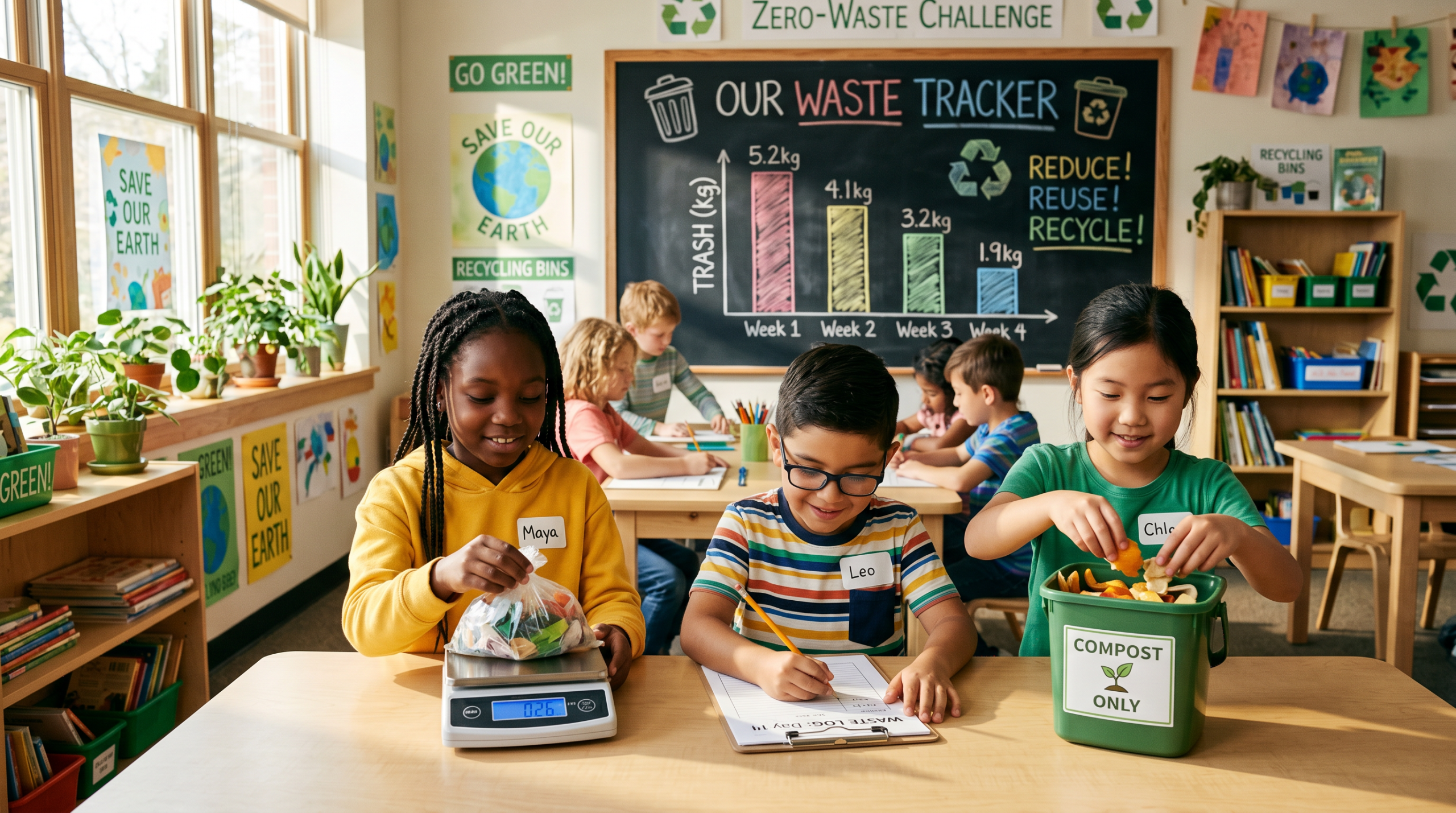
The beating heart of the challenge is measurement, and it begins with a baseline. Before changing a single habit, the class measures exactly how much waste it currently produces — typically by weighing the trash, recycling, and compost over a representative period. That first number is the reference point against which all progress will be judged, and gathering it teaches students that meaningful improvement starts with honest data about where you stand. You cannot claim to have cut your waste in half if you never knew how much you started with.
From there, measurement becomes a continuous practice rich with real math. Students weigh waste regularly and record it, building a dataset that grows over the weeks. They convert raw weights into more meaningful figures: waste per student, waste per day, or a diversion rate — the percentage of total waste kept out of the landfill through recycling and composting. They calculate percent change to see whether they are gaining ground. And they graph it all, turning a column of numbers into a visible trend line that the whole class can read at a glance. This is data literacy in its most practical form: collecting, organizing, calculating, and visualizing information about something the students genuinely care about.
The Numbers That Drive the Game
Baseline weight. How much waste you make before changing anything — your starting score.
Diversion rate. The share of waste kept out of the landfill — the headline percentage.
Per-student waste. A fair way to compare across classes and over time.
Percent change. Progress from week to week — proof the effort is working.
The richest measurement exercise is the waste audit, in which students sort a day’s trash into categories — food scraps, paper, plastic, packaging, and so on — and weigh each. The result is a breakdown that reveals exactly where the waste comes from, and it is almost always surprising. A class that assumed plastic was its biggest problem may discover that wasted food or paper towels dominate. That insight is gold, because it tells students precisely where to aim their effort for the biggest payoff. A good audit transforms vague good intentions into a targeted, evidence-based plan.
Behavioral Change: The Harder Half
Here is the part no spreadsheet can solve: knowing what to do is not the same as doing it. Every student already “knows” they should waste less, just as adults know they should exercise more. The gap between knowing and doing is where the real lesson of the zero-waste challenge lives, and it is one of the most valuable lessons in all of education, because that gap defines so much of adult life. Reducing waste means changing dozens of small, automatic, daily habits — and changing habits is genuinely hard.
The challenge teaches students how behavioral change actually works, by making them experience it. They learn that habits run on autopilot and that willpower alone is a weak tool — you cannot simply decide to be a less wasteful person and expect it to stick. They discover the power of feedback: when the scoreboard updates and the class sees its number drop, the visible progress reinforces the new behavior far more effectively than a lecture ever could. They encounter social proof, the way people follow the group’s example, which is why a whole-class challenge succeeds where individual resolutions fail — everyone is doing it together, and that shared commitment makes the new behavior the norm.
Most importantly, students learn that the smart move is to redesign the environment rather than rely on constant self-discipline. If the recycling bin is far away and the trash can is right there, people will use the trash can — not because they don’t care, but because friction shapes behavior. Move the bins, add clear labels, make reusable water bottles the default, and the easy choice becomes the right choice. This is behavioral design, and it is a profound insight for a young person to carry into adulthood: you change what you do most reliably by changing the situation around you, not by white-knuckling your way through it.
| Challenge Element | The Skill It Builds |
|---|---|
| Baseline & weighing | Measurement, units, and establishing a reference point |
| Waste audit | Sorting, categorizing, and targeting data analysis |
| Tracking & graphing | Data visualization, percent change, trend reading |
| Changing habits | Behavioral change, feedback loops, social proof |
| Redesigning the room | Behavioral design: making the right choice the easy one |
Turning It Into a Game Worth Playing
The “challenge” framing is not just packaging — gamification is what sustains the effort long enough for new habits to set. A visible scoreboard tracking the weekly diversion rate gives students a number to beat. Friendly competition between classes or grade levels adds energy, especially when paired with a shared goal the whole school is chasing. Streaks reward consistency, and celebrating milestones — the first week under a target, a record-low trash weight — keeps motivation high. These elements work because they supply exactly what behavioral change needs most: frequent, visible feedback and a sense of momentum.
Assigning roles deepens the engagement and spreads ownership. Some students manage the weighing and data entry; others design the bin labels and signage; others act as “waste watchers” who gently coach classmates at the bins; others communicate the results to the wider school. Because the challenge genuinely depends on each role, students experience accountability and teamwork as real forces, not abstractions. By the end, they are not merely participating in a teacher’s project — they are running a measurement-and-improvement operation they own, which is precisely the kind of experience that builds lasting capability.
Making the Change Stick
The biggest risk in any challenge is that enthusiasm fades once the novelty wears off and the scoreboard stops updating. The antidote is to convert the temporary push into permanent systems. New defaults — reusable bottles, double-sided printing, a working compost bin, well-placed and clearly labeled recycling — keep working long after the challenge officially ends, because they require no ongoing willpower. The class can also set a new, slightly harder target each term, so improvement continues without the effort having to feel heroic. The EPA’s recycling guidance and recycling FAQs can help a class recycle correctly so its hard-won diversion gains aren’t lost to contamination.
Done well, the challenge leaves behind something more durable than a lower trash weight: a way of thinking. Students who have measured a baseline, targeted the biggest sources, redesigned their environment, and watched the data improve have learned a repeatable method for changing any behavior, in any domain. That method — measure, target, design, track, adjust — is exactly how people improve their health, their finances, their study habits, and their work. The trash was just the training ground.
Frequently Asked Questions
Does a zero-waste challenge require special equipment?
Very little. A simple kitchen or bathroom scale to weigh waste, clearly labeled bins, and a way to record numbers — a spreadsheet or even a poster — are enough to run a rigorous, data-driven challenge.
What grade levels can do this?
All of them. Younger students can sort and weigh and watch a simple chart, while older students can calculate diversion rates, analyze audit data, and study the behavioral science of why habits are hard to change.
What’s the single most effective way to cut classroom waste?
Source reduction — not creating the waste in the first place. Switching to reusables, cutting single-use items, and printing less prevent waste entirely, which beats recycling it after the fact.
Measure It, Then Change It
A pile of classroom trash is an unlikely teacher, but it teaches two of the most useful skills there are. It demands real measurement — baselines, audits, diversion rates, and graphs that turn weight into knowledge. And it demands real behavioral change — the hard, fascinating work of turning what we know into what we actually do, day after day.
Set a target, weigh the baseline, find the biggest source, redesign the room, and watch the number fall. Students will leave with a lighter trash can and something far more valuable: a proven, portable method for improving anything they can measure. That’s a win that outlasts the challenge.
You can’t change what you don’t measure — so measure first.
This article is for general educational purposes. For authoritative guidance, see the U.S. EPA’s Reducing and Reusing Basics, Recycling Basics and Benefits, and Frequent Questions on Recycling. Supervise students during waste audits and follow local hygiene guidance when handling trash.
Leave a Reply