The Hidden River of Waste
The first thing a food-waste program reveals is the sheer invisibility of the problem. Food waste is easy to ignore because it vanishes the moment a tray is scraped into a bin. But that bin is the start of a long, costly journey. According to the USDA, the food wasted at the retail and consumer levels in a single recent year added up to roughly 133 billion pounds — food that consumed land, water, fuel, and labor to produce, only to be thrown away. For a school, the local version of this national problem is large enough to measure and, crucially, small enough to do something about.
The environmental stakes sharpen the lesson. The U.S. Environmental Protection Agency reports that food is the single largest category of material sent to municipal landfills, where it rots without oxygen and releases methane — a greenhouse gas far more potent than carbon dioxide over the short term. When students learn that the apple they tossed will sit in a landfill generating methane for years, the abstract idea of “climate change” suddenly has a concrete, personal source: their own lunch tray. That connection between a small daily action and a large global consequence is the doorway into systems thinking.
Systems Thinking: Following the Food
Systems thinking is the ability to see how parts connect into a whole — to trace inputs, outputs, flows, and feedback loops rather than viewing events in isolation. It is one of the most valuable mental skills of the modern age, and notoriously hard to teach with a worksheet. A food-waste program teaches it almost automatically, because following food through a school is following a system with clearly visible stages.
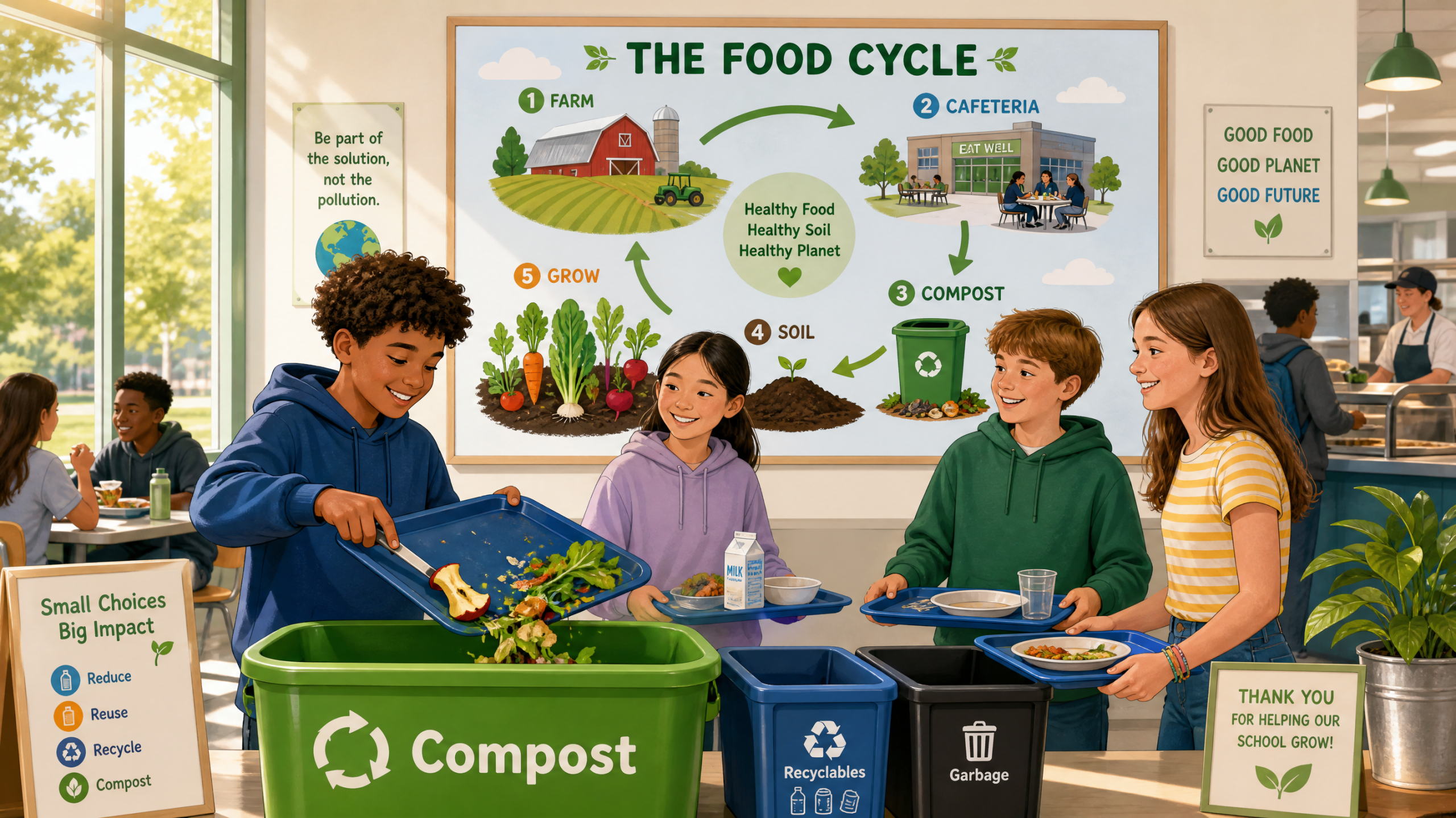
Students begin to map the journey: food is purchased and delivered (an input), prepared in the kitchen, served, partly eaten, and partly discarded (an output). The discarded portion then either goes to a landfill — a dead end — or into a compost system, where it breaks down and becomes a resource that can feed a garden, which grows more food, closing the loop. Drawing this cycle, students discover that “waste” is a choice about where an output goes, not an inevitability. They see that a change at one point in the system — serving smaller portions, offering a share table, composting scraps — ripples through every stage that follows.
The Loop, Stage by Stage
1. Input. Food is bought, delivered, and prepared — using water, energy, and money.
2. Use. Food is served and partly eaten; the rest becomes waste.
3. Output. Scraps go to a landfill (a dead end) or to compost (a resource).
4. Return. Compost feeds soil, which grows food — and the loop closes.
This loop is the heart of the lesson. In a linear, throw-it-away model, resources flow in one direction and end as garbage. In a circular model — the kind composting makes visible — outputs become inputs and nothing is truly wasted. Students who internalize this distinction have grasped one of the central ideas of sustainability and ecology, and they tend to start applying it elsewhere, noticing loops and dead ends in everything from packaging to water use. The cafeteria becomes a small, comprehensible model of how the larger world handles its resources.
The Science Inside the Compost Bin
A compost bin is not a magic box; it is a carefully balanced ecosystem, and running one teaches real biology and chemistry. Composting works because microorganisms — bacteria and fungi — consume organic matter and break it down, generating heat as they work. A well-managed pile can reach temperatures hot enough to kill weed seeds and pathogens, and students can measure that heat with a thermometer, watching the temperature rise and fall as the process moves through its stages. The EPA describes composting as a controlled, accelerated version of the natural decomposition that happens everywhere in nature.
The key to a healthy pile is balance, and that balance is a chemistry lesson in disguise. Compost needs the right ratio of “greens” — nitrogen-rich materials like food scraps and fresh clippings — to “browns,” the carbon-rich materials like dried leaves, paper, and cardboard. Too many greens and the pile turns slimy and smells; too many browns and decomposition stalls. The microbes also need oxygen, which is why a pile must be turned, and moisture, which must be kept at the dampness of a wrung-out sponge. Students managing these variables are running a living chemistry experiment, learning by trial and observation what a balanced system requires. The EPA’s guide to composting approaches lays out methods that schools of any size can adopt, from simple bins to worm-based vermicomposting.
For practical reasons, most on-site school composting sticks to vegetative scraps — fruit and vegetable waste, along with compostable paper — and avoids meat, dairy, and oils, which attract pests and create odors. That constraint itself becomes a teaching moment about what decomposes cleanly and why, and about designing a system that fits its real-world setting rather than an idealized one.
Accountability: Measuring What You Throw Away
The most transformative part of a food-waste program is the one that makes the invisible visible: the waste audit. When students actually weigh what their school throws away — sorting trays, measuring the uneaten food, and recording the numbers day after day — the problem stops being theoretical. Seeing that the cafeteria produced dozens of pounds of wasted food in a single lunch period is a jolt that no statistic can match, because the students helped create that pile and now have to look at it.
This is where accountability takes root. Accountability is not guilt; it is ownership — the recognition that your actions have measurable consequences and that you have the power to change them. A waste audit gives students hard data about their own behavior, and data is much harder to dismiss than a lecture. Once they can see the number, they naturally start asking how to lower it: Are portions too large? Is lunchtime too short for kids to finish eating? Could untouched items go on a share table for hungry classmates instead of into the trash? Each question turns a passive consumer into an active problem-solver responsible for the outcome.
And because the program runs continuously, accountability becomes a habit rather than a one-time exercise. Students can re-weigh the waste after introducing a change and prove whether it worked — closing the loop between action and result with evidence. They learn that responsibility is something you can measure and improve, not just something you feel. That lesson, practiced daily over a semester, builds a kind of ownership that transfers far beyond the lunchroom.
| Program Stage | The Skill It Builds |
|---|---|
| Mapping the food’s journey | Systems thinking: inputs, outputs, and feedback loops |
| Running the compost bin | Biology and chemistry of decomposition; balancing variables |
| Conducting a waste audit | Data collection, measurement, and honest self-assessment |
| Testing interventions | Cause and effect; proving impact with evidence |
| Assigning student roles | Accountability, teamwork, and shared responsibility |
Sharing the Responsibility
A food-waste program runs on people, which makes it a natural framework for teaching shared responsibility. Successful programs assign real jobs: compost monitors who check the pile’s moisture and temperature, sorting crews who guide classmates at the bins, data recorders who log the daily weights, and garden teams who apply the finished compost. These are not busywork roles; the system genuinely depends on each of them, and when someone skips their task, the consequence shows up — a smelly bin, a missing data point, contaminated compost.
That visible interdependence teaches accountability in a way abstract group projects rarely do. Students learn that their individual reliability affects the whole, and that a system works only when everyone holds up their part. Many schools rotate the roles so every student experiences each responsibility, building empathy for the work others do and a fuller picture of how the whole operation fits together. By the end, students aren’t just participating in a program — they are running one, and they understand from the inside what it takes to keep a real system functioning.
Closing the Loop With a Garden
The most satisfying food-waste programs don’t end at the compost bin — they connect it to a garden, completing the circle. When the compost made from last month’s lunch scraps is spread on the beds where this season’s vegetables grow, the abstract idea of a closed loop becomes something students can hold in their hands. They watch their waste literally become soil, and that soil become food, and that food return to the cafeteria. The EPA notes that finished compost enriches soil, helps it retain water, and reduces the need for chemical fertilizer — benefits students can observe directly in healthier, more productive beds.
This visible cycle is the program’s emotional and intellectual payoff. It transforms the lesson from “don’t waste food” — a rule imposed from outside — into “look what our food can become” — a possibility the students unlocked themselves. The loop, once seen, is hard to unsee. Students carry forward an instinct to ask, of any process, where the outputs go and whether they could become inputs somewhere else. That is systems thinking made permanent.
Beyond the Bin: Preventing Waste at the Source
Composting is the right destination for food that genuinely can’t be eaten, but the most sophisticated programs teach an even more important lesson: the best waste is the waste that never happens. Once students have audited their cafeteria and seen the numbers, they are ready to think like systems designers and attack the problem upstream, before food ever hits the bin. This shift — from managing waste to preventing it — is where systems thinking matures, because students learn to redesign the process rather than just clean up its outputs.
Several prevention strategies are well within a school’s reach, and each becomes a small experiment in cause and effect. Right-sizing portions and letting students decline items they won’t eat cuts waste before it starts. A share table — a designated spot where students can leave whole, unopened items for classmates who want more — rescues edible food that would otherwise be trashed and even helps feed hungry students. Something as simple as lengthening the lunch period gives children enough time to actually finish eating, which research has linked to less wasted food. Smarter purchasing, informed by the audit data, prevents the school from over-ordering in the first place.
Teaching this hierarchy — prevent first, then rescue and donate, then compost, and only as a last resort send to a landfill — gives students a powerful framework they will recognize in countless other contexts. It mirrors the logic environmental agencies use to prioritize action, and it reinforces the central insight of the whole program: a thoughtful system minimizes waste at every stage, not just at the end. Students who learn to ask “how do we stop this from being wasted in the first place?” have graduated from cleaning up a problem to preventing one — the hallmark of a true systems thinker.
Frequently Asked Questions
Do schools need a lot of space to compost?
No. Composting scales to the space available, from a small worm bin indoors to outdoor three-bin systems. Schools without room can partner with community composting sites or local farms to process their scraps.
Won’t a compost bin smell or attract pests?
A well-managed bin shouldn’t. Keeping the right balance of greens and browns, turning the pile for oxygen, and sticking to vegetative scraps (no meat, dairy, or oils) keeps odors and pests under control — and managing those variables is itself part of the learning.
How do food-waste programs help academically?
They deliver hands-on lessons in biology, chemistry, math, and environmental science, while building systems thinking, data literacy, and accountability — skills that support performance across subjects and translate directly to real-world problem-solving.
From Trash to Teacher
A pile of uneaten lunch is an unlikely classroom, but it may be one of the most honest a school can offer. It makes a hidden problem visible, hands students the data on their own behavior, and shows them — through a compost bin and a garden bed — that waste is a choice, not a fate. Along the way they learn to think in systems and to own their part in them.
The setup is modest: a few bins, a scale, some student roles, and the willingness to look at what gets thrown away. The payoff is a generation that understands loops instead of dead ends, and that knows responsibility is something you can measure, improve, and prove. Follow the food, and the lesson follows you home.
Nothing is waste until you decide it is.
This article is for general educational purposes. For authoritative information, see the USDA Food Loss and Waste resources and the U.S. EPA’s guides to composting, composting approaches, and the benefits of using compost. Follow local health and safety guidance when handling food waste.
Leave a Reply