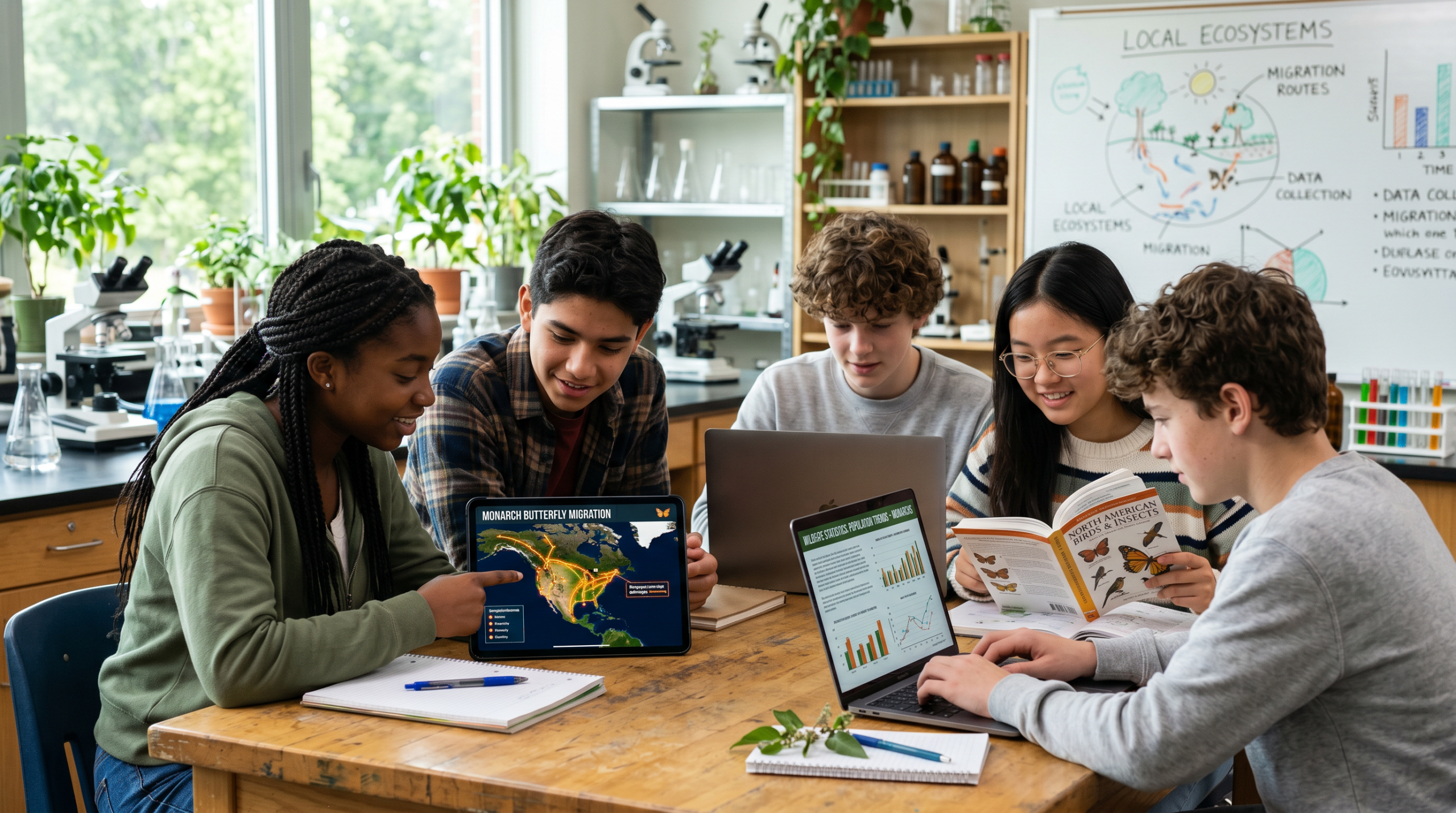
What Citizen Science Is
Citizen science — sometimes called community science — is research in which members of the public help collect or analyze data alongside professional scientists. The logic behind it is simple and powerful: some scientific questions require far more observations than any team of professionals could ever gather alone. To understand how bird populations are shifting across an entire continent, or how the timing of spring is changing, scientists need eyes and ears in thousands of places at once. Ordinary people — including students — can provide exactly that, turning a distributed crowd into a research instrument of enormous reach.
For the classroom, this represents a fundamental shift in what science education can be. Instead of a closed exercise with a known answer, students participate in open inquiry where the answer genuinely isn’t known yet — where their careful observation adds to humanity’s understanding. The data they collect about the wildlife around them flows into databases that inform conservation decisions, research papers, and policy. Few experiences are as motivating for a young person as the realization that their schoolwork is not just practice but a real, if modest, contribution to science. The work matters beyond the grade, and students feel it.
Real Projects Students Can Join
A great strength of classroom citizen science is that established, well-run projects already exist, with the infrastructure to receive and use student data. Among the best known are the bird-focused programs of the Cornell Lab of Ornithology. eBird, launched in 2002 by the Cornell Lab and the National Audubon Society, lets anyone record bird sightings that feed one of the largest biodiversity databases in the world. The Great Backyard Bird Count, first held in 1998 as the first online community-science bird project, invites people everywhere to count birds over a few days each February — an event that recently drew hundreds of thousands of participants from nearly 200 countries.
The options extend well beyond birds. Other Cornell Lab projects like Project FeederWatch and NestWatch have students monitor feeders and nest boxes, contributing data on bird behavior and reproduction. Platforms like iNaturalist let students document any living thing — plants, insects, fungi, mammals — and contribute to biodiversity research worldwide. There are projects on pollinators, water quality, weather, and more. This variety means a teacher can find a project that fits their location, season, and curriculum, and that students can choose what fascinates them. Whatever the focus, the core experience is the same: observe the real world carefully, record it well, and send it where it will be used.
How a Data Point Travels
Observe. A student carefully watches and identifies wildlife in the field.
Record. They log what, where, when, and how many — with a photo when possible.
Submit. The observation uploads to a shared scientific database.
Contribute. Researchers worldwide draw on that data to study and protect nature.
The Discipline of Data That Counts
Because the data is real, the standards are real — and this is where citizen science delivers some of its most valuable lessons. When student observations will be combined with thousands of others and used by scientists, accuracy is not optional. Students learn to follow a defined protocol exactly: counting in a standardized way, recording in a consistent format, and noting the conditions of their observation. They learn that science depends on everyone collecting data the same way, so that results can be fairly compared across time and place. A casual, inconsistent observation is little use; a careful, standardized one is gold.
Citizen science also teaches intellectual honesty in a way few exercises can. Students learn to record only what they actually observed, to mark uncertainty rather than guessing, and to resist the temptation to report what they wish they’d seen. They learn that a wrong identification submitted confidently can corrupt the data, while an honest “I’m not sure” protects it — which is why many platforms separate the act of recording an observation from the act of confirming its identity, letting a community of experts verify the trickier records. Studies have found that even first-time observers, including students, can contribute genuinely useful biodiversity data when they follow good practices. Learning to be a trustworthy data collector — careful, consistent, and honest — is a scientific virtue that serves students in every field they may later enter.
From Collecting to Understanding
Contributing data is only the beginning; the richest learning comes when students engage with the data itself. Most citizen science platforms let participants explore the information the community has gathered — maps of where species have been seen, graphs of populations over time, charts of migration and seasonal change. Students can pull up the very database they contributed to and ask real questions of it: Where do these birds spend the winter? Is this species arriving earlier than it used to? How does our schoolyard compare to other places? This turns them from data collectors into data analysts, practicing the full arc of modern science.
This access to large, real datasets is a rare and valuable thing for students. They learn to read maps and graphs built from millions of observations, to spot patterns and anomalies, and to appreciate how individual data points combine into big-picture knowledge. They see, concretely, how their single observation joins countless others to reveal something no one observer could detect — a continental migration, a population decline, a shifting range. Understanding this relationship between the individual contribution and the collective insight is one of the deepest lessons citizen science offers, and it mirrors how much of modern science, from astronomy to medicine, actually works.
| What Students Do | The Skill It Builds |
|---|---|
| Follow a protocol | Standardized methods and scientific procedure |
| Record observations | Accurate data collection and honesty about uncertainty |
| Submit to a database | Contributing to collective, real-world research |
| Explore the data | Data analysis, reading maps and graphs |
| Ask questions of it | Scientific inquiry and pattern recognition |
The Power of Many Eyes
To appreciate why a student’s single observation matters, it helps to understand the scale at which citizen science operates. No team of professional scientists, however well funded, could station observers in every backyard, park, and schoolyard across a continent on the same morning. But a crowd can. When hundreds of thousands of people each contribute a handful of careful observations, the combined dataset becomes something no individual effort could ever produce — a near-real-time portrait of life across vast areas. This is the quiet revolution citizen science represents: distributed observation at a scale that was simply impossible before.
The results have genuinely advanced science. Massive participation has allowed researchers to map bird migrations in extraordinary detail, detect species declines early enough to respond, track how warming temperatures shift the timing of seasonal events, and spot invasive species arriving in new areas. These are continental and even global patterns that emerge only when enough observations accumulate from enough places — patterns invisible to any single observer but unmistakable in the aggregate. When students learn that the data they collected sits inside one of these landmark datasets, the abstract promise that “your work matters” becomes concrete. They are not at the edge of science looking in; they are part of how some of it actually gets done.
This scale also teaches a subtle statistical lesson worth carrying forward: that reliable knowledge often comes not from a few perfect measurements but from many imperfect ones, gathered honestly and combined carefully. A single student’s count might contain a small error, but across thousands of contributors those errors tend to wash out while the real signal emerges. Understanding this — how large numbers of ordinary observations can yield trustworthy conclusions — gives students insight into how much of modern data-driven science and decision-making works, from public health to climate to economics.
Why It Matters Beyond the Classroom
The benefits of citizen science reach well past any single lesson. Students come away understanding how science actually works — not as a set of finished facts but as an ongoing, collaborative process of gathering evidence about a world we are still figuring out. They experience the motivation of authentic work, which research consistently links to deeper engagement and learning. And they develop a lasting connection to the natural world, having spent real time observing it closely and contributing to its protection. A student who has counted birds for science tends to keep noticing birds long afterward.
There is also a civic dimension. Citizen science models a kind of engaged, evidence-based participation in society — the idea that ordinary people can contribute to knowledge and to solving shared problems. Students learn that they need not be credentialed professionals to do meaningful work, that careful attention and honest reporting are contributions in themselves, and that science is something people do together. In an era of misinformation and disengagement, the experience of personally generating trustworthy data and watching it matter is a quietly powerful education in how knowledge is built and why it can be trusted. That lesson may outlast every fact they memorize.
Getting Started
Beginning is straightforward. Choose an established project that fits your setting and season — a bird count, a biodiversity survey, a pollinator project — and review its protocol with students so everyone collects data the same way. Most platforms are free and offer educator resources, and many activities need nothing more than careful observation and a way to record it; some, like seasonal bird counts, are designed to be beginner-friendly. A short practice round before the real data collection helps students get comfortable with the method and the tools.
A few practical notes smooth the way. Some platforms have age requirements for individual accounts, so younger students often participate through a class or teacher account — worth checking before you start. Building in time afterward to explore the data and discuss what students contributed turns a one-off outing into a complete scientific experience, from collection to analysis. Treat the first project as a learning run, refine your approach, and let citizen science become a recurring part of class — a standing invitation for students to step outside and add their careful observations to the great, shared project of understanding the living world.
Frequently Asked Questions
Is the data students collect really used by scientists?
Yes. Observations submitted to established platforms like eBird and iNaturalist feed real scientific databases used in research and conservation, provided they’re collected carefully and follow the project’s protocol. Quality matters, but student data genuinely counts.
Do students need to be experts to participate?
No. Most projects are designed for beginners, with identification help and clear instructions. Many platforms have experts verify observations, so students contribute valuable data even while they’re still learning to identify species.
Are there age limits for these platforms?
Some platforms set minimum ages for individual accounts, so younger students often take part through a teacher or class account. It’s worth checking each project’s rules before you begin so everyone can participate appropriately.
Real Science, Done by Students
Citizen science gives students something traditional lessons rarely can: the chance to do real science, not rehearse it. Their careful counts of birds, bugs, and blooms flow into global databases and help researchers track and protect a changing planet — turning a classroom into a genuine node of worldwide research.
Along the way, students learn the discipline of data that counts, the honesty that science demands, and the thrill of contributing to knowledge no one yet possesses. Pick a project, learn the protocol, and send students outside to observe. Their data will matter — and so, they’ll discover, do they.
One careful observation at a time, students help map the living world.
This article is for general educational purposes. To get involved, see the Cornell Lab of Ornithology’s Great Backyard Bird Count, eBird, and iNaturalist. Check each platform’s age and account rules, and supervise students during outdoor data collection.
Leave a Reply