Why Pollinators Matter
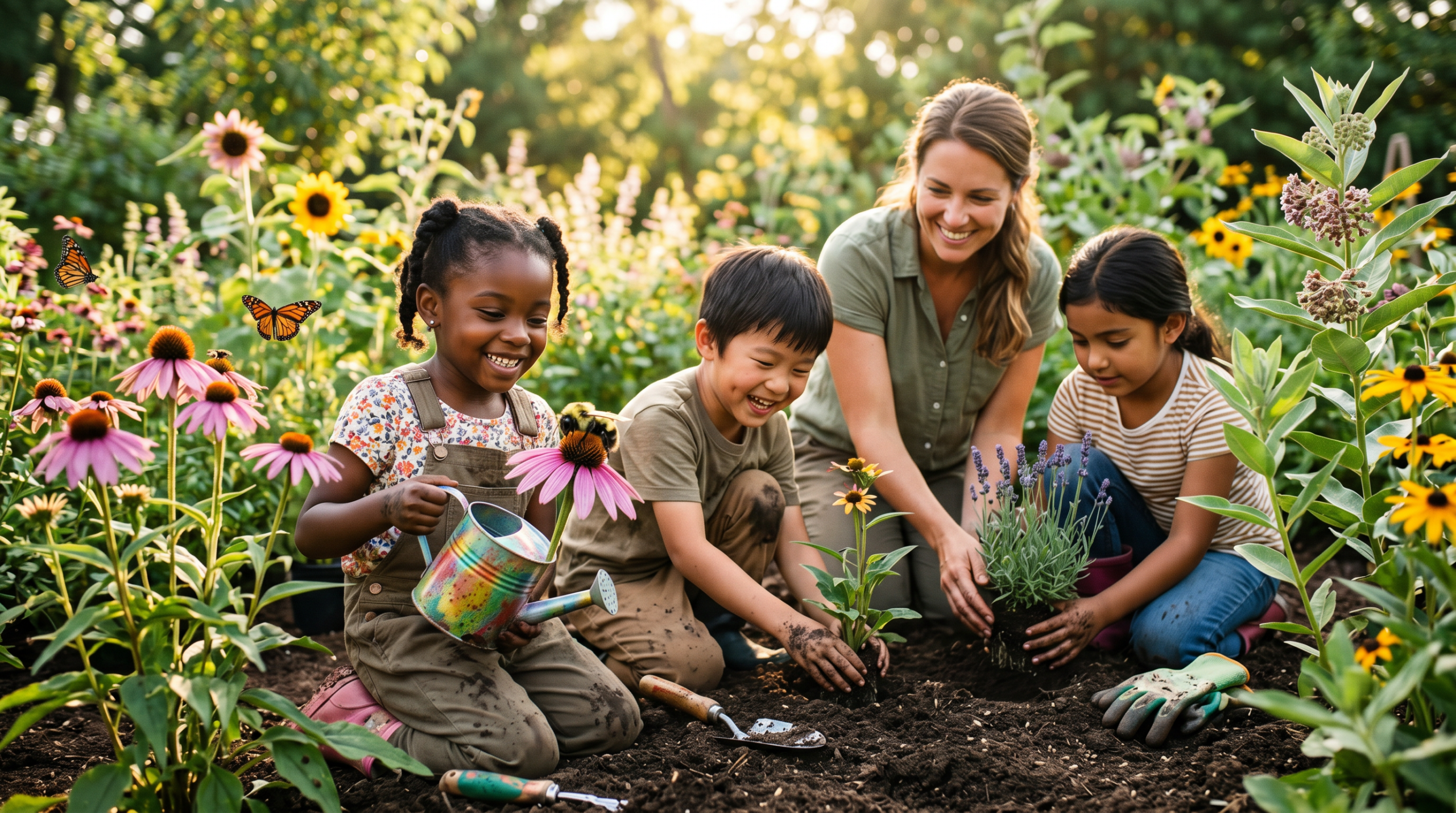
Before students plant a single seed, the pollinator garden invites a powerful question: why should we care about bees and butterflies at all? The answer reframes these small creatures as quiet heroes of life on Earth. Pollinators — bees, butterflies, moths, beetles, birds, bats, and more — carry pollen from flower to flower, fertilizing the plants that feed and shelter both people and wildlife. The USDA notes that roughly three-quarters of the world’s flowering plants and about 35 percent of global food crops depend on animal pollinators to reproduce. Apples, blueberries, almonds, melons, coffee, and chocolate all trace back to a pollinator’s visit.
This dependence makes the decline of pollinators a genuine concern, and learning about it gives the garden urgency. Many pollinator populations are shrinking due to habitat loss, pesticides, disease, and climate change. The U.S. Fish & Wildlife Service reports that numerous pollinator species are now threatened or endangered, with iconic creatures like the monarch butterfly and certain bumble bees in trouble. When students understand that the simple act of planting the right flowers helps reverse a real, serious decline, the garden stops being a craft project and becomes a meaningful contribution — a small but genuine act of conservation they can carry out with their own hands.
A Living Lesson in Ecology
A pollinator garden is ecology made visible. Ecology is the study of how living things interact with each other and their environment, and those interactions are notoriously hard to teach from a textbook because they are abstract and invisible. A pollinator garden makes them concrete. Students watch, in real time, the central relationship of mutualism: the flower offers nectar and pollen as food, and in exchange the pollinator carries pollen that lets the flower reproduce. Both partners benefit, and neither could thrive without the other. Few biological concepts are as elegant, and almost none are as easy to observe directly.
From that single relationship, a whole web of ecological ideas opens up. Students learn about food webs, seeing how pollinators connect plants to the birds and other animals that eat them or their fruits. They learn about habitat — that pollinators need not just flowers for food but also places to nest, shelter, and overwinter, and that a good garden provides all of these. They learn about specialization, discovering that some pollinators and plants are closely matched, like the monarch caterpillar that can eat only milkweed, so that losing one plant can doom an entire species. And they learn about biodiversity, observing how a garden with many kinds of plants attracts many kinds of pollinators, while a monoculture supports far fewer.
Ecology You Can Watch
Mutualism. The flower feeds the pollinator; the pollinator helps the flower reproduce.
Food webs. Pollinators link plants to the wider web of animal life.
Life cycles. Egg to caterpillar to chrysalis to butterfly — metamorphosis up close.
Biodiversity. More plant variety brings more pollinator variety.
Perhaps the most magical ecology lesson of all is metamorphosis. A pollinator garden planted with the right host plants can host the full life cycle of a butterfly — egg, caterpillar, chrysalis, and winged adult — right where students can witness it. Watching a caterpillar they have protected transform into a butterfly that then pollinates their flowers closes a loop that no diagram can rival. It makes the abstract idea of a “life cycle” unforgettable, and it gives students a front-row seat to one of nature’s most astonishing transformations.
The Responsibility of Caring for Living Things
Beyond the science, a pollinator garden teaches something harder to measure but just as important: responsibility. Caring for living creatures — even indirectly, by providing the plants they depend on — asks students to think beyond themselves and to follow through on a commitment over time. The garden does not thrive on enthusiasm alone; it needs consistent watering, weeding, and protection, and the pollinators arrive only if that care is sustained. Students learn that other living things depend on their reliability, which is a profound and grounding realization for a young person.
This responsibility has a moral dimension that pollinators bring into sharp focus. Students learn that their choices have consequences for vulnerable creatures: using pesticides can poison the very bees they hope to attract, so they learn to garden without them; tidying away every dead stem can destroy nesting sites, so they learn to leave some wildness for the insects’ sake. The Pollinator Partnership and conservation groups stress these gentle, pollinator-first practices, and adopting them teaches students to weigh their actions against the needs of other species. This is the heart of environmental stewardship — the understanding that we share the world with creatures who depend on our care, and that responsibility means acting on their behalf even when it’s inconvenient.
The responsibility is also empowering, which keeps it from feeling like a burden. Unlike many environmental problems that can leave students feeling helpless, pollinator decline has a clear, achievable, local solution: plant flowers, avoid pesticides, provide habitat. Students experience the deeply motivating feeling of doing something that actually works, of seeing more bees and butterflies arrive because of choices they made. That sense of agency — “I can help, and it matters” — is exactly the antidote to environmental despair, and it builds the kind of hopeful, active citizens the future needs.
| Garden Activity | What It Teaches |
|---|---|
| Choosing native plants | Local ecology, plant–pollinator relationships |
| Watching pollinators visit | Mutualism, food webs, observation |
| Hosting butterfly life cycles | Metamorphosis, specialization, biology |
| Ongoing care & no pesticides | Responsibility, stewardship, ethical choices |
| Seeing pollinators return | Agency, cause and effect, conservation impact |
Designing a Garden That Works
Building a pollinator garden is also a lesson in thoughtful design, because not just any flowers will do. Students learn to choose native plants, which local pollinators evolved alongside and are best able to use — an idea that itself teaches a great deal about local ecology. They learn to plant a variety of flowers that bloom across the seasons, so pollinators have food from early spring through fall, and to include host plants like milkweed that specific caterpillars need, not just nectar sources. They learn that flower shape, color, and clustering attract different pollinators, turning plant selection into an exercise in matching design to the needs of living creatures.
Good design extends beyond the flowers. A genuine pollinator habitat also offers water, shelter from wind, sunny spots for basking, and undisturbed ground or stems for nesting and overwintering. Organizations like the Xerces Society publish regional native-plant lists and habitat guides that help students design a garden suited to their specific area. Working through these choices, students practice real planning and problem-solving — researching their region, mapping the space, and making decisions based on the needs of the species they hope to attract. The garden becomes a designed system with a clear purpose, and meeting that purpose is a satisfying, multidisciplinary challenge. Students discover that design is not decoration but problem-solving — that every choice, from plant height to bloom time to where the water sits, has a reason rooted in the needs of the creatures they hope to serve. They learn to think from the pollinator’s point of view, asking what a bee or butterfly actually requires to find food, raise young, and survive the winter, and then building a space that answers those needs. This shift from designing for human taste to designing for ecological function is a sophisticated and transferable way of thinking, and it transforms a flower bed into a deliberate act of habitat creation.
From the Garden to the Community and Beyond
A pollinator garden rarely stays a private classroom project for long, and that outward reach is part of its power. Once the flowers bloom and the bees arrive, the garden becomes a visible, attractive feature of the school that students can share with the wider community. Many programs invite families and neighbors to help plant and maintain the beds, turning the garden into a hub that connects the school to the people around it. Students can create signage explaining which plants support which pollinators, host visits for younger classes, and even encourage families to plant their own patches at home — multiplying the garden’s impact far beyond the school grounds. This teaches communication, leadership, and the idea that a good environmental project inspires others to act.
The garden also becomes a launchpad for ongoing science. Rather than planting it and walking away, students can monitor it over time — counting how many pollinator species visit, noting which flowers attract the most activity, and tracking how the garden changes across the seasons. This turns the garden into a long-running observation project that builds data-collection skills and deepens ecological understanding. Many of these observations can even be contributed to broader pollinator-monitoring and biodiversity efforts, letting students see that their small garden is part of a much larger effort to understand and protect these creatures. A pollinator count repeated each year becomes a record of the garden’s success and a genuine scientific dataset.
There is a lasting lesson in this expansion: that meaningful change often starts small and spreads. A single bed of native flowers, tended by one class, can grow into a schoolwide initiative, then a community of home gardens, then a measurable improvement in local pollinator habitat. Students who experience this progression learn that environmental stewardship is not about one heroic act but about steady, contagious, collective effort — and that their corner of the world is connected to everyone else’s. That understanding, grown alongside the flowers, may be the most important thing the garden produces.
Frequently Asked Questions
How much space does a pollinator garden need?
Very little. Pollinators will use habitat wherever they find it, from a large garden bed down to a few containers or a window box. Even a small planting of the right native flowers can attract and support bees and butterflies.
What plants are best for attracting pollinators?
Native plants suited to your region work best, since local pollinators evolved with them. Include a variety that bloom across the seasons and add host plants like milkweed for caterpillars. Regional native-plant lists from groups like the Xerces Society are a great starting point.
Are bees in a school garden a safety concern?
Foraging bees and butterflies are focused on flowers and rarely bother people who observe calmly. Teaching students to watch respectfully, avoid swatting, and be mindful of any allergies keeps a pollinator garden a safe and rewarding place to learn.
Plant Flowers, Grow Stewards
A pollinator garden is one of the few classrooms where students can take real responsibility for wildlife and watch their care pay off in bees and butterflies. It turns ecology into something they witness rather than memorize — mutualism, food webs, metamorphosis, all unfolding in a bed of flowers they tend themselves.
And it teaches the kind of responsibility that sticks: choosing native plants, skipping pesticides, leaving room for nesting, and showing up to care, season after season. The reward is immediate and undeniable — more life, because of them. In a world full of problems that feel too big to fix, here is one a student can solve with a packet of seeds.
Plant for the pollinators, and watch the whole web come alive.
This article is for general educational purposes. For pollinator and native-plant resources, see the USDA, the U.S. Fish & Wildlife Service, the Pollinator Partnership, and the Xerces Society. Supervise students outdoors and be mindful of allergies.
Leave a Reply