When the Building Becomes the Curriculum
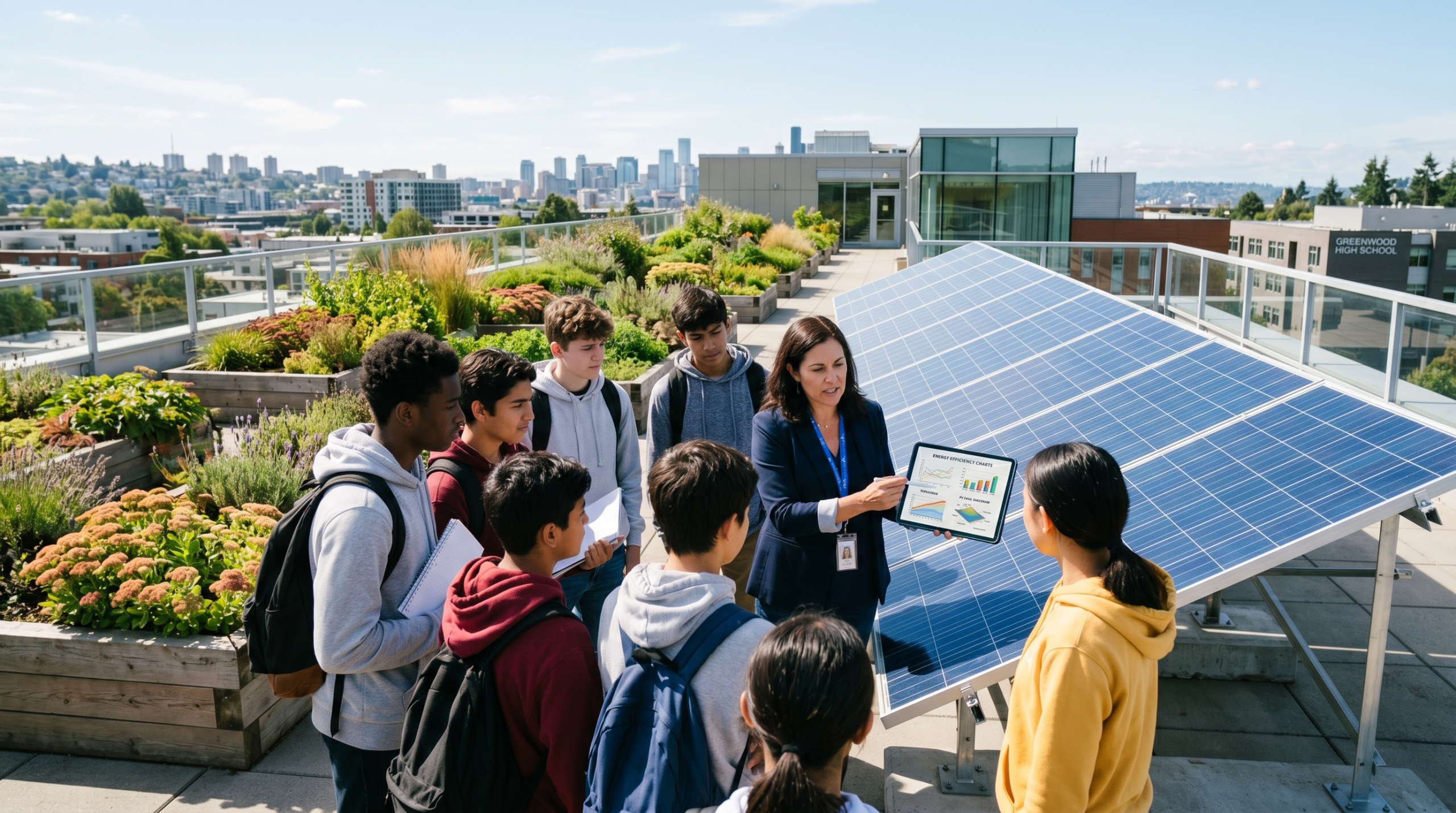
A textbook can describe a kilowatt. A solar array generates one you can watch climb and fall in real time. That is the difference a “living lab” makes. The roughly nine thousand U.S. schools with solar installations did not buy panels to teach — they bought them to cut electricity bills — but the array that saves the district money turns out to be the single most versatile teaching tool on campus. It is wired into the building’s electrical system, and increasingly into a public monitoring portal, which means a teacher can pull up today’s production on a screen and ask the only question that matters in real science: why is the number doing that?
What makes it a true laboratory is that nobody scripted the answers. A passing cloud, a winter sun low on the horizon, a film of pollen on the glass, a string of panels shaded by a new tree — each shows up as a dip in the data, and each is a problem a student can investigate, measure, and explain. The same array speaks the language of physics, of economics, and of energy policy, depending on which question you put to it. Below, we take each in turn.
The Physics on the Roof
At its heart, a solar panel is a demonstration of one of the strangest ideas in physics: that light can knock electrons loose from a material. When photons strike the silicon in a photovoltaic cell, they free electrons and set up a flow of direct current — the photovoltaic effect, the same phenomenon that won Einstein his Nobel Prize. The current the panels produce is DC; the building runs on AC, which is why every array hides an inverter, and why “how do you convert one to the other” becomes a genuine engineering question rather than a vocabulary word. The U.S. Energy Information Administration frames electricity as an energy carrier — something converted from a primary source like sunlight — and the roof makes that abstraction concrete.
From there the variables multiply, and every one of them is measurable. Irradiance — the power of sunlight hitting the panel, measured in watts per square meter — rises and falls through the day, and the output tracks it. The angle of incidence matters: panels tilted to face the sun squarely collect more energy than the same panels lying flat, which is why a winter array in the northern states produces less even on a cloudless day, because the sun sits lower. Counterintuitively, heat hurts: photovoltaic cells lose efficiency as they warm, so the single best production day of the year is often a cold, brilliant one in spring rather than a baking afternoon in July. Students who expect “hotter equals more power” and find the opposite in the data have just experienced the core of the scientific method — a prediction overturned by evidence.
Experiments the Roof Runs for Free
Clear vs. cloudy. Compare the production curve on a sunny day against an overcast one and quantify how much a cloud layer really costs.
The daily arc. Plot output hour by hour and watch it trace the sun’s path — low at dawn, peaking near solar noon, fading at dusk.
Season and angle. Track the same week in December and June to see how the sun’s height changes the yield.
The temperature surprise. Pair output with air temperature and discover why the hottest days aren’t the most productive ones.
The Economics Lesson Hiding in the Electric Bill
Solar is, before it is anything else, a money decision — and that makes it a math and economics lesson with real stakes. American K-12 districts spend more than eight billion dollars a year on energy, according to the EPA’s ENERGY STAR program, which makes the utility bill the second-largest operating cost in many districts after salaries. Every kilowatt-hour an array produces on site is a kilowatt-hour the district does not buy at retail price. Put those facts in front of students and the questions get sophisticated fast: how many panels, producing how many kilowatt-hours, at what price per kilowatt-hour, before the savings repay the cost of the system?
That last question — the payback period — is a genuine exercise in financial literacy. So is the structure many schools use to go solar without paying upfront: a power purchase agreement, in which a third party owns and maintains the panels while the school simply buys the electricity they produce, often at a rate lower and more predictable than the utility’s. Students who model this learn the difference between owning an asset and contracting for a service, the meaning of a fixed-rate hedge against rising prices, and the concept of net metering, where surplus power flowing back to the grid earns the school a credit. The most powerful figure of all is the one at the end: the dollars saved, and the fact that in a public school those dollars do not vanish into profit — they can become a teacher’s salary, a new lab, a field trip. Opportunity cost stops being abstract when the trade-off is your own school’s budget.
Energy Independence and the Lesson of the Dark Day
A panel alone stops working the moment the grid goes down — a safety feature, so line workers aren’t shocked by power flowing backward. But pair an array with battery storage and a microgrid, and the school gains the ability to “island” itself: to keep its own lights, refrigeration, and heating running on stored solar power while the surrounding neighborhood sits dark. A handful of schools have used exactly this setup to serve as emergency shelters during storms and prolonged outages, and the lesson it teaches is one no textbook conveys as well — the difference between consuming energy and controlling it.
This is where physics and economics open onto something larger: the grid itself, baseload versus peak demand, why electricity is hard to store and what changes when you finally can, and what “energy independence” means for a single building. Resources from national research institutions like the National Renewable Energy Laboratory give older students a path from the roof outside their classroom to the national questions debated by engineers and policymakers. The array becomes a doorway: start with a number on a dashboard, end with a real grasp of how a country keeps its lights on.
| Subject | What the Array Teaches |
|---|---|
| Physics | Photovoltaic effect, DC/AC conversion, irradiance, tilt angle, temperature effects |
| Math & data | Graphing production curves, averages, correlation, unit conversion (W, kW, kWh) |
| Economics | Payback period, power purchase agreements, net metering, opportunity cost |
| Civics & policy | The electric grid, energy independence, resilience, public budgets |
| Environmental science | Avoided emissions, the carbon cost of electricity, life-cycle thinking |
Turning Panels Into Lessons
The gap between “we have solar” and “we teach with our solar” is mostly a matter of access to the data — and that access is usually already built in. Most modern arrays come with a monitoring system that logs production minute by minute and often publishes it to a web dashboard the whole school can see. The richest classroom projects start there: have students download the raw figures, build their own charts rather than reading a finished one, form a hypothesis about what drives the ups and downs, and test it against the next week’s numbers. A lobby screen showing live output turns the abstract idea of “clean energy” into a number the entire community watches together.
From there the cross-curricular possibilities open up naturally. A science class measures efficiency; a math class models the payback; an economics class debates the power purchase agreement; a civics class researches how the district funded it and who decided; an art or writing class tells the school’s energy story to the public. The most successful programs treat the array not as a one-time science demonstration but as a permanent dataset that refreshes every single day — a laboratory that never closes and never repeats itself. The panels were bought to save money. The education they make possible may be worth even more.
A Power Plant You Can Learn From
A rooftop array is rare among teaching tools because it is completely real. The kilowatts are real, the savings are real, the dip when a cloud passes is real, and the dark day it could carry the building through is real. That authenticity is exactly what makes it teach physics, economics, and energy independence at once — three subjects most students meet only on paper, here running live above their heads.
For a school weighing solar, the lesson is simple: the panels will pay for themselves in electricity, but they can pay a second time in education if the data is put in students’ hands. Pull up the dashboard, ask why the number moves, and let the building answer. The roof is already running the experiment — all that’s left is to let the class watch.
The best lab in the school may be the one on top of it.
This article is for general educational purposes. For data and resources on solar in schools and energy education, see Generation180, the U.S. EPA’s ENERGY STAR for K-12 Schools, the EIA Energy Kids program, and the National Renewable Energy Laboratory.
Leave a Reply